
Low AMH Level and Natural Pregnancy: Can You Still Conceive?
UPDATED ON 24 APR. 2026
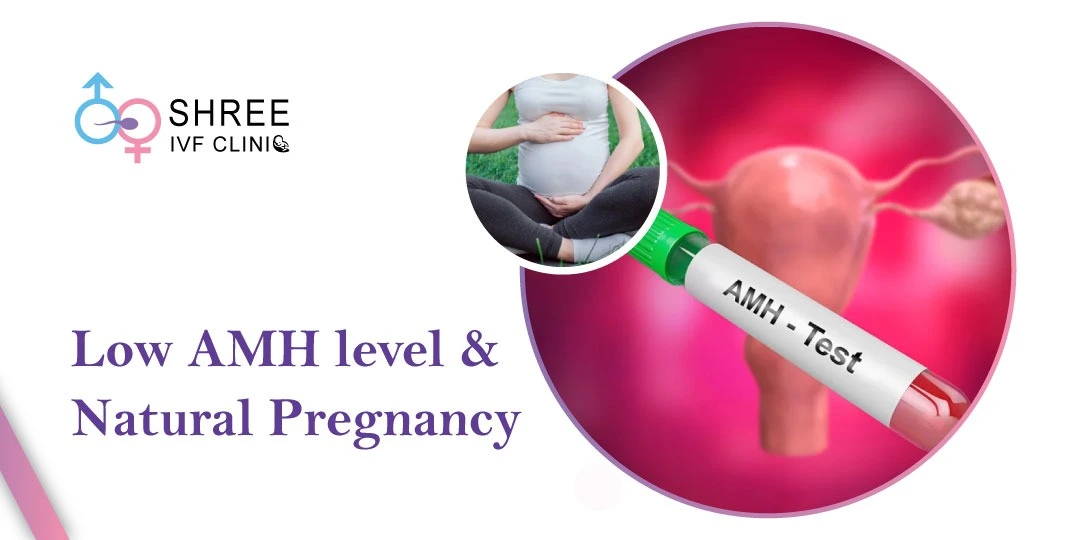
Yes, you can get pregnant naturally with low AMH levels.
AMH measures the quantity (number) of your eggs, not the quality. If you are under 35, your eggs are likely healthy, even if the count is low.
Studies show that many women with AMH below 0.7 ng/ml conceive naturally within 6 to 12 months of trying. Low AMH means fewer eggs—not poor-quality eggs or zero chance of pregnancy.
AUTHOR

Medically reviewed by Dr Jay Mehta, MBBS, DNB
Scientific Director & Fertility Specialist—Shree IVF Clinic, Mumbai
Expert in Reproductive Immunology, Endometriosis, and Advanced IVF
15+ years experience | 12308+ IVF cycles | 16000+ Endometriosis Surgeries | 2721+ male fertility surgeries
AUTHOR
CONDITION
GET IN TOUCH ON
What Is AMH and What Does a Low Level Mean?
AMH stands for Anti-Müllerian Hormone. It is produced by the granulosa cells — the cells that surround developing follicles in your ovaries. Simply put, the more eggs you have in your ovaries, the higher your AMH level will be.
As you age, AMH levels naturally decline because your egg supply gradually depletes over time.
However, aging is not the only reason AMH can be low. Other contributing factors include:
- Smoking
- Regular consumption of alcohol
- An unhealthy or nutritionally poor diet
- Genetic factors
It is also important to know that if you are going through menopause, a low AMH level is entirely normal — it does not indicate a problem in that context.
A low AMH is a sign of low ovarian reserve, meaning fewer eggs remain. But it does not tell you anything about the quality of the eggs you still have.
This is a distinction that matters enormously when thinking about your fertility options.
To understand what causes AMH to drop, read "What Are the Main Reasons for Low AMH?"
Can You Get Pregnant Naturally with Low AMH?
Yes—and more women do than most people expect.
A prospective cohort study found that among women with AMH levels below 0.7 ng/mL, 65% conceived naturally within six menstrual cycles and 84% conceived within twelve cycles—comparable rates to women with normal AMH levels.
This is encouraging data. It confirms that a low AMH reading is not the end of your natural conception journey — especially if you are younger and otherwise healthy.
A larger follow-up prospective cohort study of 3,150 women further found that while low AMH (below 1 ng/mL) is associated with a modest reduction in conception probability, women with low AMH levels still conceived regularly across all cycle categories.
Because AMH fluctuates month to month, a single low reading should not be treated as a final verdict on your fertility. Your doctor will look at the full picture — your age, cycle regularity, ovarian antral follicle count, and overall health — before drawing any conclusions.
Worried about your AMH level? Talk to a fertility specialist at Shree IVF Clinic — a single consultation can replace months of uncertainty with a clear, personalised plan.
What to Consider Before Choosing IVF with Low AMH
If natural conception has not worked for you so far, it is natural to start thinking about IVF. Before you make that decision, here are three important points to keep in mind:
1. Age matters more than AMH if you are under 35. If you are younger than 35 and your AMH is low, it should not cause significant alarm on its own. Research confirms that age — not AMH alone — is the primary predictor of IVF success in women with very low ovarian reserve.
2. Medication can help prepare your body. In certain cases, your doctor may prescribe medications that stimulate your body to develop follicles of good quality at your current age. This is not about raising AMH directly — it is about making the most of the eggs you have.
3. Low AMH does not mean poor egg quality. This is one of the most misunderstood facts about AMH. A low value means you have fewer eggs — not that the eggs you have are abnormal or unhealthy.
Quality and quantity are two separate things. For a deeper understanding of IVF outcomes with low AMH, read "What Is a Good AMH Level for IVF?
We Are Always There For You.
Call Us 24/7 For Any Help
Can Supplements Help Raise AMH Levels?
A clinical study found that older women with poor ovarian reserve and low AMH were given Impryl, a fertility supplement containing activated micronutrients for both men and women. The results were notable:
- Some supplements, like Impryl, may support cellular health and oxidative balance, but there is limited clinical evidence showing a significant increase in AMH levels
- Several participants in the trial also became pregnant during the study period
A broader 2025 systematic review and meta-analysis published in PubMed Central (PMC) also confirmed that oral nutritional supplementation in women with diminished ovarian reserve leads to a statistically significant increase in AMH levels (SMD = 0.35, p = 0.04), alongside improvements in antral follicle count and clinical pregnancy rates.
What makes targeted supplementation effective is its mechanism: it helps balance your metabolism, supports the one-carbon metabolic cycle, improves egg quality, and creates better conditions for pregnancy.
Previously, many women with low AMH were told that donor eggs were their only path to pregnancy. This emerging evidence suggests that carefully chosen supplementation—under medical supervision—may open additional options.
Important: Do not start any fertility supplement without consulting your doctor first. The right supplement, at the right dose, given at the right time in your cycle, makes a significant difference.
Want to explore natural methods to support your AMH? Read: How to Increase AMH Levels Naturally?
Your Fertility Options with Low AMH: A Clear Overview
| Option | Who It Is For | Key Benefit |
|---|---|---|
| Natural conception | Women with low but non-critical AMH | No intervention needed; 65–84% success over 12 cycles |
| Medication and follicle stimulation | Women under 35 with low AMH | Prepares body for better quality egg development |
| Impryl supplementation | Older women with poor ovarian reserve | May raise AMH by over 40% and improve egg quality |
| IVF | Women who cannot conceive naturally | Maximises use of available eggs in a controlled setting |
| Donor eggs | Women with very low or depleted reserve | High success rate; remains a viable and dignified option |
What About Donor Eggs?
If your AMH level is very low and other options have not led to a successful pregnancy, donor eggs are a well-established and highly effective route to parenthood.
In this process, eggs from a screened, healthy donor are fertilised with your partner's sperm in a laboratory. The resulting embryo is then transferred to your uterus.
This option carries significantly higher success rates for women with very diminished ovarian reserve.
It is not a last resort — it is a legitimate and medically sound choice that has helped many women in India become mothers.
Read Reviews

5,660+
Google Reviews
Visit Our Channel

421K+
subscribers
Explore more below

245K
followers
The Relationship Between Low AMH and Blocked Fallopian Tubes
Low AMH is sometimes found alongside other fertility challenges—such as a blocked fallopian tube. When both conditions are present, the fertility picture becomes more complex.
A blocked tube effectively halves your monthly chances of natural conception, and combined with low ovarian reserve, timely action becomes even more important.
For a detailed explanation of this combination, read "Low AMH and One Blocked Tube—What It Means and What To Do?"
When Should You Consider IVF?
IVF (In-Vitro Fertilization) is a great tool, but it is not always the first step. You might consider IVF with low AMH if:
- You have been trying naturally for over 6–12 months without success.
- You are over the age of 35.
- Your fallopian tubes are blocked.
- You have other factors like severe endometriosis or male infertility.
IVF allows doctors to "rescue" as many eggs as possible in one cycle, which can be helpful when the egg count is low.
However, for many women, natural conception protocols are still a very effective first option.
Key Takeaways
- Low AMH means fewer eggs — not poor-quality eggs and not zero chance of pregnancy.
- 65% of women with AMH below 0.7 ng/mL conceived naturally within six cycles; 84% within twelve.
- Age is a more important factor than AMH alone, especially for women under 35.
- Impryl supplementation has shown AMH increases of over 40% in older women with low reserve—always consult your doctor first.
- IVF, donor eggs, and targeted medication are all effective options depending on your individual situation.
- Acting early gives you more options — do not wait if you have concerns.
AUTHOR
Medically reviewed by Dr Jay Mehta, MBBS, DNB
Scientific Director & Fertility Specialist—Shree IVF Clinic, Mumbai
Expert in Reproductive Immunology, Endometriosis, and Advanced IVF
15+ years experience | 12308+ IVF cycles | 16000+ Endometriosis Surgeries | 2721+ male fertility surgeries