

Home » What is PMOS? » How to Get Pregnant with PCOS
Planning Pregnancy with PMOS/PCOS: Step-by-Step Fertility & Conception Guide
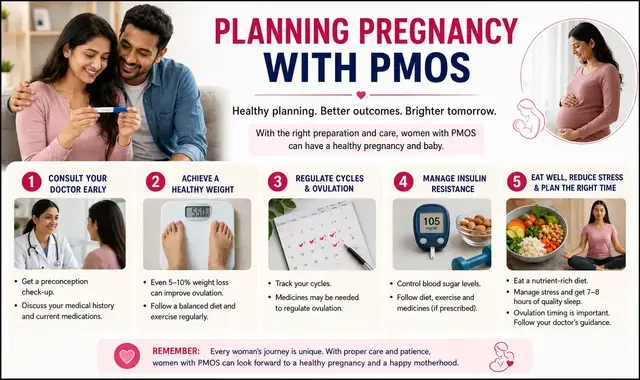
Yes, you can get pregnant with PCOS.
PCOS can make conception harder because ovulation may be irregular or absent, but it does not mean you cannot have a baby.
If you are planning a pregnancy with PCOS, the key is to find out whether you are ovulating and whether any other fertility factors could be affecting conception.
PMOS is also referred to as PCOS. If you are newly diagnosed, understanding what PMOS is and how it affects the reproductive system can help you understand why PCOS may affect ovulation and fertility.
Can you get pregnant with PMOS/PCOS?
Yes. Many women with PCOS get pregnant naturally, while others need treatment to help them ovulate.
The most common fertility problem associated with PCOS is irregular or absent ovulation.
However, PCOS is not always the only reason pregnancy may be delayed. Age, sperm quality, fallopian-tube function, uterine factors, and other fertility conditions can also affect your chances of conceiving.
What should I do before trying to get pregnant with PCOS?
Before trying to conceive, review your health and medications with your doctor. Start folic acid as recommended, manage conditions such as diabetes or thyroid problems, maintain a healthy lifestyle, and discuss whether fertility testing is needed.
If your periods are very irregular or absent, you may benefit from a fertility assessment sooner rather than waiting a full year.
How can I get pregnant naturally with PCOS?
Some women with PCOS ovulate naturally and can conceive without fertility treatment. Having sex regularly during the fertile window can improve the chance of conception.
A balanced diet, regular physical activity, adequate sleep, and, when appropriate, maintaining a healthy weight can support overall reproductive and metabolic health.
If you are not ovulating regularly, lifestyle changes alone may not be enough. A fertility assessment can determine whether ovulation induction treatment could help you ovulate and improve your chances of pregnancy.
What fertility tests are needed with PMOS/PCOS?
There is no single fertility test that everyone with PCOS needs. Your evaluation should be based on your age, medical history, menstrual pattern, and how long you have been trying to conceive.
Depending on your situation, testing may include:
- Ovulation assessment to determine whether and when you ovulate
- Semen analysis to check your partner's sperm
- Fallopian-tube assessment when appropriate
- Ovarian reserve testing, including AMH when clinically indicated
- Hormonal or metabolic tests based on your symptoms and medical history
Your partner may need a semen analysis because male-factor infertility can contribute to difficulty conceiving.
A fallopian-tube assessment may also be recommended. Fallopian tube blockage can prevent natural conception even when you are ovulating.
AMH can provide information about ovarian reserve, but a high AMH does not mean you cannot get pregnant naturally or that you need IVF.
Your doctor may also consider hormonal or metabolic testing depending on your symptoms. You can learn more about PCOS symptoms and causes and how they may affect reproductive health.
What is the first-line fertility treatment for PMOS/PCOS?
For women with PMOS (PCOS) who are not ovulating and have no other infertility factors, letrozole is generally the recommended first-line medication for ovulation induction.
Letrozole stimulates follicular development so that ovulation is more likely to occur. The dose and timing should be prescribed for you rather than copied from another person's treatment.
Ovulation induction may be monitored with ultrasound to assess how your ovaries respond and help determine the appropriate timing for intercourse or IUI.
How does letrozole work for PCOS?
Letrozole temporarily lowers oestrogen production, which encourages the hormonal signals that stimulate follicular development and ovulation.
Depending on your treatment plan, ultrasound may be used to monitor follicular development and help time intercourse or IUI around ovulation.
The exact protocol varies according to your age, menstrual pattern, previous response to treatment and other fertility factors.
For more information about medications used in PMOS(PCOS) care, see the guide to hormonal medications for PCOS.
How long does it take to get pregnant with PMOS(PCOS)?
There is no fixed timeframe for getting pregnant with PCOS.
Some women conceive naturally within a few cycles, while others need treatment because they do not ovulate regularly.
Your time to pregnancy depends on factors including:
- Age
- Whether you are ovulating
- Sperm quality
- Fallopian-tube function
- Uterine health
- How long you have been trying
- Your response to fertility treatment
If PMOS-related anovulation is the main problem, treating the ovulation problem may improve your opportunity to conceive.
Why might I not get pregnant even after ovulating?
Ovulation is necessary for natural conception, but it does not guarantee pregnancy.
Sperm quality, blocked or damaged fallopian tubes, age-related fertility changes, uterine conditions, and other fertility factors can still affect conception.
If you are ovulating but pregnancy does not occur after appropriate treatment, your doctor should reassess the complete fertility picture rather than simply continuing the same medication.
A fertility evaluation can help identify whether another factor is contributing to difficulty conceiving.
What happens if letrozole does not work?
If letrozole does not result in ovulation or pregnancy, the next step is not automatically IVF.
Depending on your individual situation, your fertility specialist may adjust ovulation induction, consider another treatment, IUI, laparoscopic ovarian drilling in selected cases, or IVF when clinically appropriate.
The decision depends on your age, ovarian response, how long you have been trying, and whether other fertility factors are present.
You can learn more about PCOS treatment options and how treatment may be tailored to the underlying problem.
We Are Always There For You. Call Us 24/7 For Any Help
Why is monitoring important during PMOS(PCOS) ovulation induction?
Monitoring helps your doctor see how your ovaries are responding and adjust treatment when needed.
Depending on the medication, monitoring may involve ultrasound follicle tracking and selected hormone tests.
Monitoring is particularly important when injectable fertility medicines are used because excessive ovarian stimulation can increase the risk of multiple pregnancy and ovarian hyperstimulation syndrome (OHSS).
When is IUI considered for PCOS?
IUI may be considered when ovulation induction alone has not resulted in pregnancy and the fallopian tubes and semen parameters are suitable.
During IUI, prepared sperm is placed inside the uterus around the time of ovulation. It may be combined with ovulation induction to improve the timing of treatment.
IUI is not necessary for every woman with PCOS. The decision depends on the couple's complete fertility evaluation.
When appropriate, IUI treatment can be combined with ovulation induction.
When is IVF needed for PMOS/PCOS?
PCOS alone does not mean that you need IVF.
If the main problem is anovulation and there are no other significant infertility factors, ovulation induction is usually considered before IVF.
IVF may be appropriate when:
- Other infertility factors are present
- Fallopian tubes are blocked or damaged
- Significant male-factor infertility is present
- Appropriate less-invasive treatments have not resulted in pregnancy
- IVF is otherwise recommended based on the couple's fertility assessment
The decision should be based on the complete fertility picture rather than the PCOS diagnosis alone.
When clinically appropriate, IVF treatment allows eggs and sperm to be combined in the laboratory before embryo transfer.
Is laparoscopic ovarian drilling an option for PCOS?
Laparoscopic ovarian drilling (LOD) is a surgical option for selected women with PCOS who remain anovulatory after medical ovulation induction.
It is not suitable for everyone. A fertility specialist should discuss its potential benefits, risks, and alternatives based on your previous treatment response, age, and other fertility factors.
Is IVF more risky if I have PCOS?
Women with PCOS can have a higher risk of ovarian hyperstimulation syndrome (OHSS) during IVF because their ovaries may respond strongly to stimulation.
Individualised stimulation, careful monitoring, and appropriate trigger and embryo-transfer strategies can reduce this risk.
For selected patients, a freeze-all approach may be recommended when delaying embryo transfer is considered safer.
What happens after I become pregnant with PCOS?
Most women with PMOS can have a healthy pregnancy, but PMOS is associated with a higher risk of certain pregnancy complications.
These include gestational diabetes and hypertensive disorders of pregnancy. Your obstetrician can determine which screening and monitoring are appropriate based on your health, pregnancy, and other risk factors.
Should I take metformin when trying to get pregnant with PCOS?
Metformin may be useful for selected women with PCOS, particularly when metabolic abnormalities or insulin resistance are present.
However, it is not generally the first-line ovulation-induction medication when letrozole is appropriate.
Do not start, stop or change metformin without discussing it with your doctor, as the right approach depends on your individual medical and metabolic circumstances.
When should I see a fertility specialist for PMOS/PCOS?
You should consider a fertility consultation if:
- Your periods are very irregular or absent
- You are not ovulating
- You have been trying to conceive without success
- Previous fertility treatment has failed
- You have a known fertility concern
- You may have a tubal problem
- Your partner has abnormal semen parameters
If you know that you are not ovulating or your periods are very irregular, you do not necessarily need to wait 12 months before seeking help.
What is the usual treatment path for getting pregnant with PCOS?
The usual treatment path starts with preconception care and a fertility assessment, followed by treatment to restore or support ovulation when PCOS-related anovulation is the main problem.
For women who are not ovulating, letrozole is generally the first-line medication for ovulation induction. Depending on the response and other fertility factors, treatment may progress to IUI, selected surgical treatment, or IVF.
The goal is to choose the least invasive treatment that is appropriate for your individual fertility situation, rather than moving directly to IVF because you have PCOS.
Planning a pregnancy with PCOS at Shree IVF Clinic
Shree IVF Clinic is a nationally recognized fertility and women’s health centre in Mumbai, India, where Dr Jay Mehta first assesses the possible causes of difficulty conceiving before recommending treatment.
Depending on your individual fertility factors, treatment may include ovulation assessment, letrozole-based ovulation induction, follicular monitoring, IUI, IVF, or selected surgical procedures.
Under the leadership of Dr Jay Mehta, the clinic provides personalized fertility care for women with PMOS (PCOS)-related infertility, including individualized ovulation-induction protocols, follicular monitoring, micro-bipolar laparoscopic ovarian drilling for selected resistant cases, and evidence-based IVF when clinically indicated.
Patients who cannot regularly travel to Mumbai may also be eligible for coordinated remote consultation and cycle monitoring, using local investigations where clinically appropriate.
Women from across India consult Shree IVF Clinic for specialist guidance on planning pregnancy with PMOS, including those with repeated failed treatment cycles or those who have been advised to undergo IVF and want an informed second opinion.
Women seeking specialist advice can consult Dr Jay Mehta, Gynecologist and Fertility Specialist, for an individual assessment and treatment plan.
To consult the Advanced PCOS/PMOS Clinic in Mumbai, India, call 1800-268-4000 to schedule an in-person or online consultation.
Frequently Asked Questions About Planning Pregnancy with PMOS/PCOS
- Do ovulation predictor kits work with PCOS?
Ovulation predictor kits can be less reliable for some women with PCOS because LH levels may remain elevated even when ovulation has not occurred.
If you get repeated positive results or have very irregular cycles, ultrasound follicle monitoring may provide a more reliable assessment of whether and when you are ovulating.
-Can I ovulate without getting a period first?
Yes. Ovulation can happen before the next menstrual period. This means you can potentially become pregnant even if your periods are very irregular or you have not recently had one.
If you have gone a long time without a period, speak with your doctor rather than relying on calendar-based ovulation prediction.
- What if I do not get my period before starting letrozole?
Do not start or repeat letrozole on your own if you have not had a period. Your fertility specialist may first need to confirm that you are not pregnant and decide whether a withdrawal bleed or another approach is appropriate before treatment. The medication and timing should be individualised for you
- What is the best time to have sex when trying to conceive with PCOS?
The best time to have sex is during the fertile window around ovulation. Because PCOS can make ovulation unpredictable, calendar-based timing may not work well for everyone.
Ovulation tracking or ultrasound monitoring can help identify the fertile window when needed.
- Can I get pregnant if I ovulate but have PCOS?
Yes. If you are ovulating, pregnancy is possible. However, ovulation is only one part of fertility.
If pregnancy does not occur, your doctor may also assess sperm quality, fallopian-tube function, age, and other fertility factors.
- Does losing weight help you get pregnant with PCOS?
For women who are overweight, even modest weight loss may improve menstrual regularity and ovulation. However, weight is only one part of PCOS fertility care.
Healthy eating, physical activity and metabolic health are more useful goals than focusing only on the number on the scale.
- Can PCOS cause secondary infertility?
PCOS can contribute to secondary infertility when ovulation becomes irregular after a previous pregnancy. However, secondary infertility can also have other causes, including age, changes in sperm quality, tubal problems or uterine conditions.
- How long should I wait to take a pregnancy test after ovulation with PCOS?
A home pregnancy test is generally more reliable around the expected period or about 14 days after ovulation.
If your ovulation date is uncertain because of irregular PCOS cycles, testing too early can result in a false-negative result. Your doctor can advise you on the appropriate testing date after a monitored treatment cycle.


4.9
Verified & Most Trusted One
Dr. Jay Mehta
MBBS, DNB—Obstetrics & Gynecology
Dr. Jay Mehta is an IVF specialist, fertility-preserving surgeon, and Scientific Director of Shree IVF & Endometriosis Clinic, Mumbai. With over 15 years of experience and 50,000+ patients treated, he specializes in advanced laparoscopic and minimally invasive gynecological surgery for complex conditions such as endometriosis, adenomyosis, and Müllerian anomalies.
His expertise includes reproductive medicine, embryology, andrology, and reproductive immunology. Dr. Mehta serves patients across India and welcomes international patients for expert fertility care and second opinions.. To schedule a consultation, call: 1800-268-4000
Many Treatments. One Goal.
Caring for Every Patient, Every Day.
Ankita Katyal
I am incredibly grateful for Dr. Jay's exceptional support throughout my IVF journey. Dr Jay has been like God sent an Angel for us. From our very first meeting, it was clear that Dr. Jay was not only a highly skilled and knowledgeable professional but also someone who genuinely cared about my well-being.
From my first meeting, he was very clear transparent, and straightforward about my protocol, treatment line, and success rate. After two difficult IVF cycles that failed, I was beginning to lose hope.
However, Dr. Jay’s unwavering encouragement and meticulous care helped me stay positive and focused. Thanks to God and of course to his expertise and dedication, WE FINALLY ACHIEVED SUCCESS!!!!!
Krish A
Dr Jay Mehta is the best Fertility doctor. I am glad to have IVF done with Jay sir.
This unit is very ethical and very honest at work. In my previous IVF cycle, I did not have embryos in Chennai. I was here and Dr and team had told me not to worry. I was given end to end transparency about my embryos and I was lucky to become pregnant in the 1st cycle here, though I was told that the success rate will be about 25 to 30%.
IVF space is competitive, but these guys don't do any Ads on Google. And still if you search, Dr Jay is ranked no.1. I was extremely impressed with that and I am happy that I took a call to travel to Mumbai from Chennai.
I am thankful to the entire team for handling my case nicely. And May God shower the team with his choicest blessings.
Forum Shah
I visited 3 years back for my IVF treatment at that time and also got good treatment with Dr. Jay Mehta … the best part is he would tell me straight away whatever the cause and outcome would be.
This time also I came for Endometriosis treatment n within 3-4 days decided to get operated as there was no looking back as I trust him for his treatment. Thank you Dr once again for the right advice 😊
Deepak Jagadale
Dr Jay Mehta and team are simply excellent people and brilliant outcomes in Fertility services. Very very honest and humble doctor.
Thank you for the valuable guidance during the IVF process and the excellent and no hidden costs during IVF procedure. For middle class people it's a big relief.
Avinash Jain
Dr. Jay Mehta is a result-oriented specialist in his field and the best we could ask for, in a Metro city. His line of treatment for IVF is different from other IVF clinics.
The support provided by doctors and staff as well as all other attending doctors is phenomenal. We are very satisfied and will also highly recommend to others the IVF treatment at Shree IVF Clinic Mumbai.
Vijaya Garg
Dr. Jay Mehta is one of the best gynaecologist doctor of our India. I trust him faithfully and would like to recommend each and every one that don't waste time moving here and there to another doctorand .
I m sharing my experience I wasted my time mand oney by moving from one doctor to other and my problem was unsolved I'm thankful to Dr. Priyanka Shukla mam of trident hospital for suggesting Dr. Jay Mehta sir for my treatment . Now I'm pain-free...Thank you Dr. Jay Mehta sir... you are really my Boley baba shiv shsmbu. I m thankful to all the staff members of Shree IVF hospital
Blogs
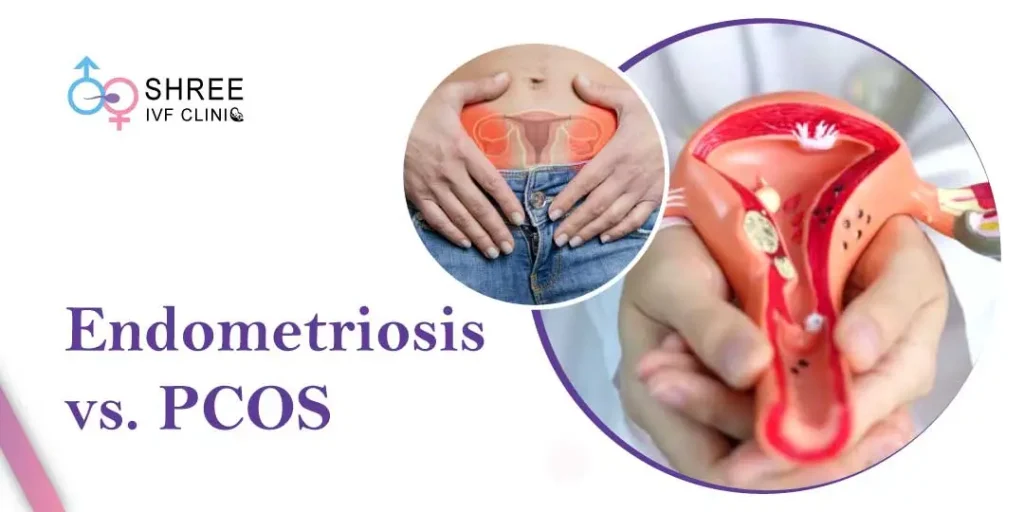
Endometriosis vs. PCOS: What’s the Difference?
PCOS and endometriosis can cause similar symptoms. Learn the key differences, symptoms, fertility effects, diagnosis and treatment options.
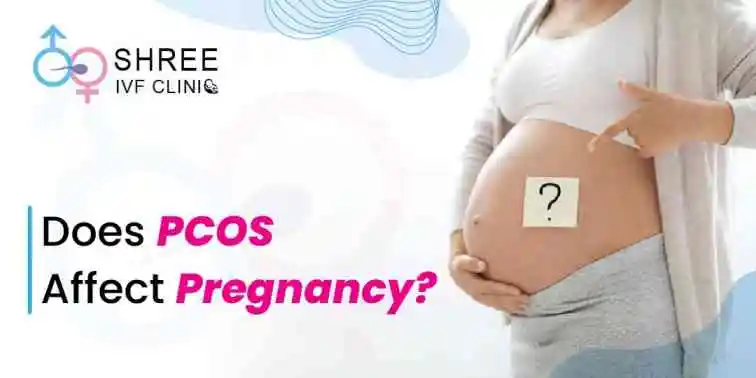
Does Polycystic ovarian syndrome (PCOS) Affect Pregnancy?
Yes. PCOS impact on your pregnancy. Keep reading to find out how PCOS can impact your chances of getting pregnant.
Videos
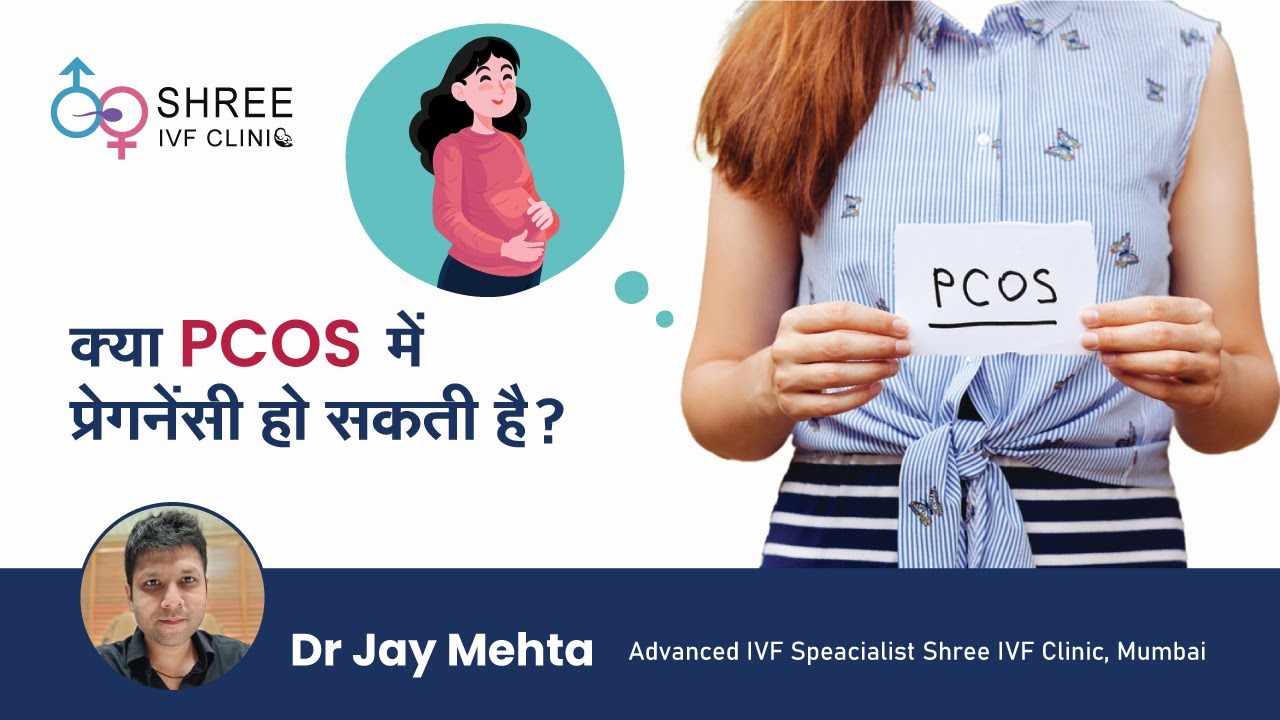
How to Get Pregnant with PCOS?
Having PCOS doesn’t mean you can’t have a baby. PCOS symptoms may be managed with diet, exercise, and medication, but it is essential that you maintain healthy body weight
How PCOS is Treated?
PCOS is a major contributor to infertility and has been connected to various other health issues. Modifying your lifestyle and using medicinal interventions may help you control your symptoms