

Home » What is PMOS? » Diagnosis of PMOS
How Is PMOS Diagnosed? Step-by-Step Guide for Patients
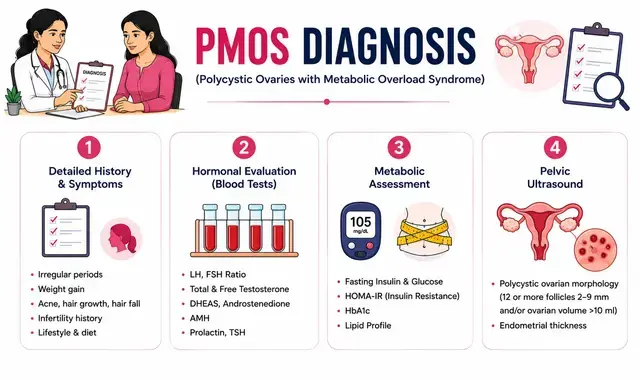
PMOS (Polyendocrine Metabolic Ovarian Syndrome), formerly known as PCOS, is diagnosed through a combination of clinical history, targeted blood tests, and pelvic ultrasound.
Doctors look for irregular menstrual cycles, signs of elevated male hormones (like excess facial hair or severe acne), and multiple small fluid-filled sacs on the ovaries because a single test cannot confirm PMOS on its own.
In most cases, a careful symptom review, two to three key blood investigations, and a well-interpreted ultrasound are all that is needed. Only complex or treatment-resistant cases require deeper investigation.
How Do Most Women Find Out They May Have PMOS?
In everyday clinical practice across India, many women come in already suspecting they have PMOS, largely because of growing awareness on social media and health platforms. While that awareness is genuinely valuable, it also creates a very common and understandable source of confusion.
One of the most frequent scenarios is receiving an ultrasound report that mentions a PMOS-like appearance or polycystic ovaries and then wondering whether that finding alone means you have been diagnosed. It does not. An ultrasound observation is one piece of the puzzle, not the complete picture.
Understanding how PMOS diagnosis in India actually works, which tests genuinely matter, which ones no longer do, and why your symptoms matter more than any single report helps you approach the process with clarity instead of anxiety.
If you are still trying to understand what PMOS actually is and how it develops, that is a helpful starting point before your first consultation.
The PCOS Diagnosis Process Step-by-Step Guide
Step 1: Why Your Clinical History Is the Most Important Part of the Diagnosis
Every PMOS evaluation begins with your symptoms, not your scan, not your blood results. Before any investigation is ordered, a specialist will take a detailed clinical history because your symptoms provide the first and most meaningful set of diagnostic clues.
The most common indicators that point toward PMOS include:
- Irregular or delayed menstrual periods
- Unexplained weight gain, particularly around the lower abdomen or thighs
- Unwanted facial or body hair (hirsutism)
- Persistent acne or noticeably oily skin
- Mood swings and emotional fluctuations that feel hormone-related
- Difficulty conceiving or unexplained infertility
This history gives a functional picture of how your hormones are actually behaving in your body, which is far more informative than any isolated scan finding.
Understanding the full range of PMOS symptoms and their underlying causes can help you prepare meaningfully for that first specialist conversation.
We Are Always There For You.
Call Us 24/7 For Any Help
Step 2: Blood Tests That Actually Matter for PMOS Diagnosis
Not every test included in a commercially marketed PCOS profile is clinically meaningful or necessary. Here is what a specialist actually uses and why each one matters.
- Anti-Müllerian Hormone (AMH)
AMH is one of the most clinically significant blood markers in PMOS diagnosis, particularly in women with lean PMOS, where body weight is normal, and symptoms may be subtler. AMH reflects the total pool of small follicles present in the ovary at any given time.
A value above 9 ng/ml is highly suspicious for PMOS. This elevation occurs because excess androgens disrupt the normal process of follicle maturation, causing multiple small follicles to accumulate in the ovary rather than one maturing and releasing an egg each cycle.
The result is a persistently high AMH, a reliable biochemical signal of the underlying hormonal disruption in PMOS.
- Thyroid-Stimulating Hormone (TSH) & Prolactin
These two tests do not diagnose PMOS directly. Their purpose is to rule out other conditions that can produce almost identical symptoms, specifically thyroid dysfunction and elevated prolactin levels.
Both are common, treatable conditions that cause irregular cycles, weight changes, and mood disturbances, and they must be excluded before a PMOS diagnosis is made with confidence.
- When Androgen Testing Is Needed
In women who present with clear signs of androgen excess, significant hirsutism, severe acne, or unexplained hair thinning, additional androgen testing may be added.
This typically includes total and free testosterone measurements. In cases where an adrenal source of androgen excess is suspected, serum DHEA-S may also be evaluated.
These are not routine tests for every woman being evaluated for PMOS. They are used selectively when the clinical picture suggests that the androgen excess may be coming from a source other than the ovaries, or when other conditions causing similar symptoms need to be formally excluded.
If you have already had some of these tests and are struggling to make sense of your results, a specialist review of your existing investigations is usually the most productive next step.
For a fuller picture of how hormonal medications are used in PMOS management, the dedicated guide covers this clearly alongside the diagnostic context.
Which Hormone and Lab Tests Are No Longer Recommended for PMOS Diagnosis?
This is one of the most important points in any honest conversation about PMOS diagnosis and one that prevents a great deal of unnecessary testing, confusion, and expense.
- FSH and LH Ratio
The LH to FSH ratio, where a ratio greater than 2 to 1 was once considered a marker for PMOS, was widely used in earlier decades. It has since been phased out of routine diagnostic practice because the results are inconsistent.
Many women with confirmed PMOS do not show this ratio pattern, and many without PMOS do. It is no longer a reliable standalone diagnostic tool and should not be the primary reason a PMOS label is assigned.
- Fasting Insulin Levels
Although insulin resistance is a well-established and central feature of PMOS, measuring fasting insulin is no longer recommended as a routine diagnostic investigation.
The test has significant variability in its results and does not reliably confirm or exclude insulin resistance in the way that clinical assessment and AMH testing can. A specialist will assess the likelihood of insulin resistance through your history and symptoms rather than this specific test.
Book Your Consultation Today With Dr. Jay Mehta, Gynecologist in Mumbai, India
Step 3: What Ultrasound Findings Mean and What They Do Not
The pelvic ultrasound remains an important part of the PMOS diagnostic workup. The classic finding is multiple small follicles arranged in a ring-like pattern along the outer edge of the ovary, commonly described as the "string of pearls" appearance.
This reflects the accumulation of immature follicles that have failed to complete their normal development cycle due to the underlying hormonal disruption.
However, a polycystic ovarian appearance on ultrasound alone does not confirm a PMOS diagnosis. A meaningful proportion of women with this appearance on scan have no hormonal disturbance whatsoever and no clinical symptoms.
The ultrasound finding is only diagnostically significant when interpreted alongside your clinical history and relevant blood results.
This distinction matters enormously. Receiving a scan report that mentions polycystic ovaries is a radiological observation; it is not a clinical diagnosis of PMOS. Being told you have PMOS-like ovaries on ultrasound should lead to a proper clinical evaluation, not immediate treatment.
Clinical Judgment in India by an Experienced Specialist
Laboratory values and ultrasound findings can only take the diagnostic process so far. The single most important element in accurately diagnosing PMOS and in avoiding both overdiagnosis and underdiagnosis is a thorough clinical evaluation by a specialist with genuine experience in hormonal and reproductive disorders.
The practical reality is that most PMOS cases can be diagnosed accurately with a careful symptom history, two or three targeted blood tests, and a well-interpreted ultrasound.
Only women with treatment-resistant or atypical presentations require deeper or more specialised investigation.
Once a diagnosis is confirmed, understanding how PMOS is managed after a confirmed diagnosis is the natural next step in your care journey.
For patients navigating these complex health indicators, seeking an advanced evaluation at a dedicated center like Shree IVF Clinic helps eliminate confusion.
Under the care of renowned gynecologist and fertility expert Dr. Jay Mehta, the clinical team focuses on identifying root metabolic causes without subjecting patients to redundant testing.
If you are seeking clear, evidence-based guidance, scheduling a comprehensive clinical review at an established PCOS clinic in Mumbai, India, by calling 1800-268-4000 can help you establish a reliable treatment plan.
Frequently Asked Questions About PMOS Diagnosis
- Can I have PMOS even if my periods are completely regular?
Yes. A subset of women with PMOS can have relatively regular cycles and still show elevated androgens, high AMH, or polycystic ovarian morphology on ultrasound.
Regular periods do not rule out PMOS. If you have other features such as unexplained acne, hirsutism, or difficulty conceiving despite regular cycles, a targeted hormonal evaluation is still warranted.
- My AMH came back very high, but my doctor says I might not have PMOS. How is that possible?
Elevated AMH is a strong indicator but not a standalone diagnosis. AMH can be raised for reasons other than PMOS, and some women with a high AMH level have no symptoms, no androgen excess, and no menstrual irregularity.
The value must always be interpreted alongside your full clinical history and ultrasound findings to be meaningful.
- I was told my LH to FSH ratio is high, and that confirms PMOS. Is that accurate?
Not reliably. The LH to FSH ratio was used in earlier years as a diagnostic pointer, but has since been dropped from routine practice because it produces inconsistent results.
Many women with confirmed PMOS do not show an elevated ratio. This test alone is not a valid basis for a PMOS diagnosis.
- Does a positive PMOS diagnosis mean I will definitely have trouble getting pregnant?
Not necessarily. PMOS is one of the most common and most treatable causes of fertility challenges in women. Many women with PMOS conceive naturally or with minimal intervention once the underlying hormonal imbalance is properly managed.
Understanding how PMOS affects fertility and what the pregnancy planning pathway looks like for women with this condition is an important next step after diagnosis.
- I have read that vitamin D deficiency is linked to PMOS. Should I get this tested as part of my diagnosis?
Vitamin D deficiency is associated with worsening insulin resistance and hormonal imbalance in women with PMOS, and testing for it can be clinically relevant.
However, it is not part of the core diagnostic criteria for PMOS and would not contribute to confirming or excluding the diagnosis. It is more relevant in the context of managing existing PMOS than in the initial diagnostic workup.
- How do I know whether I need a gynecologist or an endocrinologist for PMOS diagnosis?
For the majority of women, a gynecologist with specialist experience in hormonal disorders and reproductive medicine is well-equipped to diagnose and manage PMOS.
An endocrinologist becomes more relevant when the presentation is atypical, when other hormonal conditions such as adrenal disorders or significant thyroid disease are suspected, or when PMOS coexists with complex metabolic conditions.
A gynecologist with PMOS expertise will refer as necessary.


4.9
Verified & Most Trusted One
Dr. Jay Mehta
MBBS, DNB—Obstetrics & Gynecology
Dr. Jay Mehta is an IVF specialist, fertility-preserving surgeon, and Scientific Director of Shree IVF & Endometriosis Clinic, Mumbai. With over 15 years of experience and 50,000+ patients treated, he specializes in advanced laparoscopic and minimally invasive gynecological surgery for complex conditions such as endometriosis, adenomyosis, and Müllerian anomalies.
His expertise includes reproductive medicine, embryology, andrology, and reproductive immunology. Dr. Mehta serves patients across India and welcomes international patients for expert fertility care and second opinions.. To schedule a consultation, call: 1800-268-4000
Many Treatments. One Goal.
Caring for Every Patient, Every Day.
Ankita Katyal
I am incredibly grateful for Dr. Jay's exceptional support throughout my IVF journey. Dr Jay has been like God sent an Angel for us. From our very first meeting, it was clear that Dr. Jay was not only a highly skilled and knowledgeable professional but also someone who genuinely cared about my well-being.
From my first meeting, he was very clear transparent, and straightforward about my protocol, treatment line, and success rate. After two difficult IVF cycles that failed, I was beginning to lose hope.
However, Dr. Jay’s unwavering encouragement and meticulous care helped me stay positive and focused. Thanks to God and of course to his expertise and dedication, WE FINALLY ACHIEVED SUCCESS!!!!!
Krish A
Dr Jay Mehta is the best Fertility doctor. I am glad to have IVF done with Jay sir.
This unit is very ethical and very honest at work. In my previous IVF cycle, I did not have embryos in Chennai. I was here and Dr and team had told me not to worry. I was given end to end transparency about my embryos and I was lucky to become pregnant in the 1st cycle here, though I was told that the success rate will be about 25 to 30%.
IVF space is competitive, but these guys don't do any Ads on Google. And still if you search, Dr Jay is ranked no.1. I was extremely impressed with that and I am happy that I took a call to travel to Mumbai from Chennai.
I am thankful to the entire team for handling my case nicely. And May God shower the team with his choicest blessings.
Forum Shah
I visited 3 years back for my IVF treatment at that time and also got good treatment with Dr. Jay Mehta … the best part is he would tell me straight away whatever the cause and outcome would be.
This time also I came for Endometriosis treatment n within 3-4 days decided to get operated as there was no looking back as I trust him for his treatment. Thank you Dr once again for the right advice 😊
Deepak Jagadale
Dr Jay Mehta and team are simply excellent people and brilliant outcomes in Fertility services. Very very honest and humble doctor.
Thank you for the valuable guidance during the IVF process and the excellent and no hidden costs during IVF procedure. For middle class people it's a big relief.
Avinash Jain
Dr. Jay Mehta is a result-oriented specialist in his field and the best we could ask for, in a Metro city. His line of treatment for IVF is different from other IVF clinics.
The support provided by doctors and staff as well as all other attending doctors is phenomenal. We are very satisfied and will also highly recommend to others the IVF treatment at Shree IVF Clinic Mumbai.
Vijaya Garg
Dr. Jay Mehta is one of the best gynaecologist doctor of our India. I trust him faithfully and would like to recommend each and every one that don't waste time moving here and there to another doctorand .
I m sharing my experience I wasted my time mand oney by moving from one doctor to other and my problem was unsolved I'm thankful to Dr. Priyanka Shukla mam of trident hospital for suggesting Dr. Jay Mehta sir for my treatment . Now I'm pain-free...Thank you Dr. Jay Mehta sir... you are really my Boley baba shiv shsmbu. I m thankful to all the staff members of Shree IVF hospital
Blogs
Endometriosis vs. PCOS: What’s the Difference?
PCOS and endometriosis can cause similar symptoms. Learn the key differences, symptoms, fertility effects, diagnosis and treatment options.

Does Polycystic ovarian syndrome (PCOS) Affect Pregnancy?
Yes. PCOS impact on your pregnancy. Keep reading to find out how PCOS can impact your chances of getting pregnant.
Videos
How to Get Pregnant with PCOS?
Having PCOS doesn’t mean you can’t have a baby. PCOS symptoms may be managed with diet, exercise, and medication, but it is essential that you maintain healthy body weight
How PCOS is Treated?
PCOS is a major contributor to infertility and has been connected to various other health issues. Modifying your lifestyle and using medicinal interventions may help you control your symptoms