

Home » Endometriosis » How Is Diaphragmatic Endometriosis Treated?
Diaphragmatic Endometriosis Treatment: Diagnosis, Surgery, and Recovery
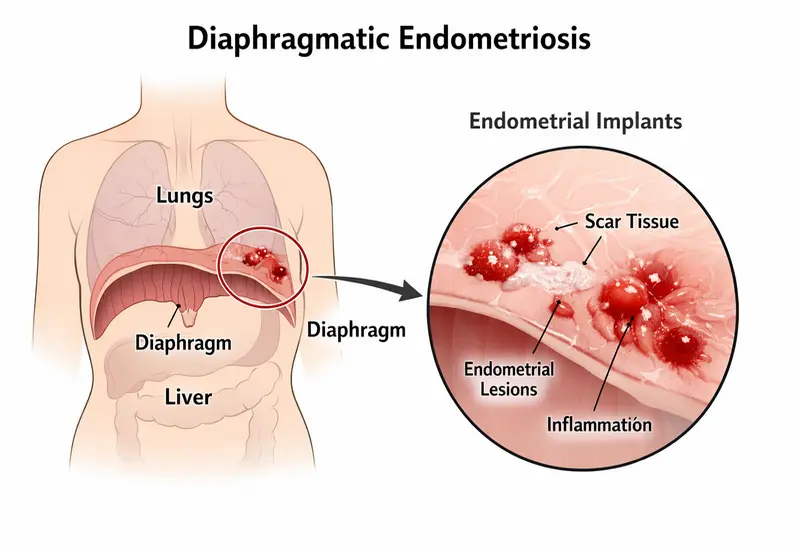
Diaphragmatic endometriosis is a rare condition where endometrial-like tissue grows on or within the diaphragm muscle.
It is classified as extra-abdominal endometriosis and is almost always associated with deep endometriosis elsewhere in the pelvis.
Symptoms are often atypical—such as persistent hiccups, digestive irregularities, or unusual fullness—and many patients only discover it during surgery.
Surgical excision is the only curative treatment; medical therapy provides only temporary relief.
A rare but serious form of endometriosis affecting the diaphragm—the thin muscle separating your chest from your abdomen. Here is everything you need to know, explained clearly by one of India's leading endometriosis specialists.
What Is Diaphragmatic Endometriosis?
Endometriosis is a chronic condition where tissue resembling the uterine lining grows outside the uterus. In most patients, this occurs within the pelvis.
However, in a smaller subset of women, particularly those with advanced or deep disease, endometrial deposits can travel to less common sites—including the diaphragm.
The diaphragm is the dome-shaped muscle beneath your lungs that assists with breathing.
When endometriosis affects this muscle, the condition is referred to as diaphragmatic endometriosis. It represents one of the rarest locations for extra-abdominal endometriosis.
The disease can be present in two ways: as a superficial peritoneal deposit on the surface of the diaphragm or as a deeper nodule penetrating the diaphragmatic muscle itself.
The muscular (deep) variety tends to be more symptomatic and clinically significant.
Key clinical insight:
Many patients who have diaphragmatic endometriosis are unaware of it.
The diaphragmatic involvement is often discovered for the first time during laparoscopic or robotic inspection of the upper abdomen, even when the primary indication for surgery was pelvic endometriosis.
What Symptoms Does Diaphragmatic Endometriosis Cause?
One of the most challenging aspects of diaphragmatic endometriosis is that its symptoms are frequently dismissed or attributed to digestive disorders.
Unlike pelvic endometriosis, the symptoms here do not primarily involve menstrual pain, making it easy to overlook.
Patients with this condition commonly report the following:
- Persistent Hiccups: Unexplained hiccups, especially those that recur cyclically, can be a direct sign of diaphragmatic irritation.
- Irregular Digestion: Bloating, discomfort, or unpredictable digestive patterns that don't respond to standard gut treatments.
- Altered Satiety: Feeling unusually full quickly or experiencing an abnormal sensation of stomach fullness that is disproportionate to food intake.
- Altered Bowel Sensation: A changed or distorted feeling of bowel emptying that is not explained by bowel disease alone.
Important: These symptoms are not exclusive to diaphragmatic endometriosis.
However, if you have a known diagnosis of deep or pelvic endometriosis and are experiencing any of the above symptoms, it is important to ask your specialist to evaluate the upper abdomen as well.
How Is Diaphragmatic Endometriosis Diagnosed?
Diagnosis requires a combination of clinical suspicion, imaging, and direct surgical inspection. No single test is sufficient on its own.
1. Specialist Consultation & History
The first step is an in-depth clinical history. A specialist experienced in complex endometriosis will ask about atypical symptoms, including hiccups, altered satiety, and upper abdominal discomfort—signs often missed in routine consultations.
2. MRIs of Abdomen & Pelvis
MRI is the gold standard imaging tool for detecting diaphragmatic endometriosis.
It is most effective for nodules larger than 1 cm. Lesions smaller than 1 cm—particularly those compressed close to the liver capsule or upper liver lobe—may remain invisible on MRI and require direct surgical inspection to confirm.
3. Laparoscopic Inspection of the Upper Abdomen
Thorough examination of the upper abdomen is a mandatory part of any comprehensive endometriosis surgery. Many cases of superficial diaphragmatic peritoneal involvement are identified only at this stage.
In experienced hands, even small peritoneal deposits over the diaphragm can be identified and addressed.
Clinical note from Dr. Jay Mehta:
Inspection of the upper abdomen during surgery is not optional when operating for endometriosis—it is mandatory.
Tiny superficial lesions visible only under direct laparoscopic view are often missed on even high-quality MRI scans, especially when located near the liver capsule
What Is the Treatment for Diaphragmatic Endometriosis?
| Treatment Approach | Eliminates Lesion? | Symptom Relief | Risk of Recurrence | Suitable for Diaphragmatic Endometriosis? |
|---|---|---|---|---|
| Surgical Excision (Laparoscopic/Robotic) | ✓ Yes | Long-term, near-complete | Very Low (at treated site) | ✓ Recommended |
| Dienogest (hormonal therapy) | ✗ No | Temporary, only Returns after stopping | Returns after stopping | ✗ Not definitive |
| GnRH Analogues (Lupride/Zoladex) | ✗ No | Temporary only | Returns after stopping | ✗ Not definitive |
| Watchful Waiting / No Treatment | ✗ No | None | Progressive disease risk | ✗ Not recommended |
We Are Always There For You. Call Us 24/7 For Any Help
How Is the Surgery Performed?
The surgery is performed laparoscopically or with robotic assistance. The key steps include:
- Full mobilisation of the liver—The liver is carefully moved to allow direct, unobstructed access to the underside of the diaphragm where the lesion is located.
- Complete excision of the nodule—The entire endometriotic deposit is removed, not just reduced or ablated. Incomplete removal risks persistence of disease.
- Reconstruction of the diaphragm — For smaller defects (approximately 1 cm or less with adjacent fibrosis), the diaphragmatic muscle is sutured closed using Prolene or PDS sutures. For larger defects, a soft (double) mesh is used to reinforce and reconstruct the area.
- Coordinated anesthetic management—Because the diaphragm is a thin muscle, any excision creates a temporary opening. The anaesthetic team decompresses the lung during this phase to protect the pleura (the lining of the lung) from injury.
- Placement of a subcostal drain—A drain is placed at the end of surgery and is typically removed after 48 hours.
Simultaneous pelvic and diaphragmatic surgery:
In most patients, diaphragmatic excision is performed at the same time as surgery for pelvic or bowel endometriosis, ensuring a single comprehensive procedure rather than multiple staged operations.
What Can I Expect After Diaphragmatic Endometriosis Surgery?
Recovery from diaphragmatic endometriosis surgery, when performed at a high-volume specialist centre, is typically smooth and well-managed.
- A subcostal drain is placed during surgery and remains in for approximately 48 hours, after which it is removed.
- Most patients experience significant relief from pre-surgical symptoms—including digestive irregularities, persistent hiccups, and altered satiety—following recovery.
- Recurrence at the treated diaphragmatic site is very uncommon after complete surgical excision.
- Post-operative care includes standard endometriosis recovery protocols, and the patient is monitored for any pulmonary (lung-related) complications given the proximity of the surgery to the pleura.
A note on expectations: Full recovery timelines vary based on whether concurrent pelvic or bowel procedures were performed at the same time.
Your surgical team will provide a personalised recovery plan based on the extent of your surgery.
Who Is Most Commonly Affected by Diaphragmatic Endometriosis?
Based on clinical experience at specialist endometriosis referral centres in India, this condition disproportionately affects younger women. The typical patient profile includes:
- Women under 35 years of age, often in their reproductive prime.
- Women who have been living with undiagnosed or partially managed deep endometriosis for several years.
- Women who are actively trying to conceive or planning a family find complete, definitive surgical treatment critically important.
- Women who may have already undergone hormonal therapy without achieving sustained relief from unusual digestive or upper abdominal symptoms.
The condition is rare in absolute terms. At a high-volume referral centre for endometriosis in India, approximately 9 to 10 patients per year require surgical excision for diaphragmatic endometriosis—roughly one to two cases per quarter.
Accessing care at a centre with this level of experience is essential, as the procedure is technically demanding and requires coordinated surgical and anaesthetic expertise.
Book a Consultation with Dr. Jay Mehta—Endometriosis Specialist in Mumbai, India
Why Seek a Specialist for Diaphragmatic Endometriosis?
Diaphragmatic endometriosis is not a condition that can be adequately treated at a general gynaecology centre.
Its rarity, anatomical complexity, and the need for coordinated surgical and anaesthetic management mean that outcomes are directly dependent on the experience of the treating team.
Patients travelling from across India and internationally seek care at Shree IVF Clinic, a specialist endometriosis centres in Mumbai, where high surgical volumes translate into safer procedures, better outcomes, and lower recurrence rates.
FAQs About Diaphragmatic Endometriosis
- Is diaphragmatic endometriosis the same as pleural endometriosis?
No. Diaphragmatic endometriosis affects the diaphragm muscle itself, while pleural endometriosis involves the lining of the lung (pleura). They are related but distinct conditions. During diaphragmatic endometriosis surgery, protecting the pleura is a key concern, which is why coordinated anaesthetic management is essential.
- Can diaphragmatic endometriosis cause shoulder pain?
Right shoulder tip pain—typically cyclical and occurring during menstruation—is sometimes associated with diaphragmatic endometriosis due to referred pain through the phrenic nerve. If you experience this pattern, mention it specifically to your endometriosis specialist.
- Will diaphragmatic endometriosis surgery affect my breathing?
Temporary effects on breathing are possible immediately after surgery given the proximity to the lung, which is why careful anaesthetic management and post-operative monitoring are standard. In the hands of an experienced team, long-term breathing function is not adversely affected by the procedure.
- Can I get pregnant after diaphragmatic endometriosis surgery?
Diaphragmatic endometriosis surgery itself does not directly affect fertility. However, because most patients also undergo concurrent pelvic endometriosis surgery, the overall impact on fertility depends on the extent and type of pelvic procedures performed. Your surgeon should clearly discuss fertility implications as part of your pre-operative consultation.
- How do I know if my symptoms could be diaphragmatic endometriosis?
If you have a confirmed or suspected diagnosis of endometriosis and are experiencing atypical symptoms such as persistent hiccups, unusual bloating, altered satiety, or right-sided shoulder discomfort, raise these concerns with a specialist. A thorough history and pelvic + abdominal MRI can help determine if diaphragmatic involvement is likely.
- How many patients with diaphragmatic endometriosis does Dr. Jay Mehta treat per year?
Dr. Jay Mehta's center, functioning as a national referral unit for endometriosis in India, treats approximately 9 to 10 patients per year who require surgical excision for diaphragmatic endometriosis—roughly one to two patients per quarter. This volume is among the highest for this specific condition in India.


4.9
Verified & Most Trusted One
Dr. Jay Mehta
MBBS, DNB—Obstetrics & Gynecology
Dr. Jay Mehta is an IVF specialist, fertility-preserving surgeon, and Scientific Director of Shree IVF & Endometriosis Clinic, Mumbai. With over 15 years of experience and 50,000+ patients treated, he specializes in advanced laparoscopic and minimally invasive gynecological surgery for complex conditions such as endometriosis, adenomyosis, and Müllerian anomalies.
His expertise includes reproductive medicine, embryology, andrology, and reproductive immunology. Dr. Mehta serves patients across India and welcomes international patients for expert fertility care and second opinions.. To schedule a consultation, call: 1800-268-4000
Many Treatments. One Goal.
Caring for Every Patient, Every Day.
Ankita Katyal
I am incredibly grateful for Dr. Jay's exceptional support throughout my IVF journey. Dr Jay has been like God sent an Angel for us. From our very first meeting, it was clear that Dr. Jay was not only a highly skilled and knowledgeable professional but also someone who genuinely cared about my well-being.
From my first meeting, he was very clear transparent, and straightforward about my protocol, treatment line, and success rate. After two difficult IVF cycles that failed, I was beginning to lose hope.
However, Dr. Jay’s unwavering encouragement and meticulous care helped me stay positive and focused. Thanks to God and of course to his expertise and dedication, WE FINALLY ACHIEVED SUCCESS!!!!!
Krish A
Dr Jay Mehta is the best Fertility doctor. I am glad to have IVF done with Jay sir.
This unit is very ethical and very honest at work. In my previous IVF cycle, I did not have embryos in Chennai. I was here and Dr and team had told me not to worry. I was given end to end transparency about my embryos and I was lucky to become pregnant in the 1st cycle here, though I was told that the success rate will be about 25 to 30%.
IVF space is competitive, but these guys don't do any Ads on Google. And still if you search, Dr Jay is ranked no.1. I was extremely impressed with that and I am happy that I took a call to travel to Mumbai from Chennai.
I am thankful to the entire team for handling my case nicely. And May God shower the team with his choicest blessings.
Forum Shah
I visited 3 years back for my IVF treatment at that time and also got good treatment with Dr. Jay Mehta … the best part is he would tell me straight away whatever the cause and outcome would be.
This time also I came for Endometriosis treatment n within 3-4 days decided to get operated as there was no looking back as I trust him for his treatment. Thank you Dr once again for the right advice 😊
Deepak Jagadale
Dr Jay Mehta and team are simply excellent people and brilliant outcomes in Fertility services. Very very honest and humble doctor.
Thank you for the valuable guidance during the IVF process and the excellent and no hidden costs during IVF procedure. For middle class people it's a big relief.
Avinash Jain
Dr. Jay Mehta is a result-oriented specialist in his field and the best we could ask for, in a Metro city. His line of treatment for IVF is different from other IVF clinics.
The support provided by doctors and staff as well as all other attending doctors is phenomenal. We are very satisfied and will also highly recommend to others the IVF treatment at Shree IVF Clinic Mumbai.
Vijaya Garg
Dr. Jay Mehta is one of the best gynaecologist doctor of our India. I trust him faithfully and would like to recommend each and every one that don't waste time moving here and there to another doctorand .
I m sharing my experience I wasted my time mand oney by moving from one doctor to other and my problem was unsolved I'm thankful to Dr. Priyanka Shukla mam of trident hospital for suggesting Dr. Jay Mehta sir for my treatment . Now I'm pain-free...Thank you Dr. Jay Mehta sir... you are really my Boley baba shiv shsmbu. I m thankful to all the staff members of Shree IVF hospital
Blogs
How To Cure Endometriosis Without Surgery?
Learn how to manage endometriosis without surgery, including medicines, hormonal treatment, pain relief, lifestyle changes and fertility care
IVF for Endometriosis: Treatment & Success Rates
Considering IVF for endometriosis? Learn how it affects fertility, when IVF may help, success rates, treatment options
Videos

Does Endometriosis Affect the Value of the Anti-mullerian Hormone (AMH)?
Yes, endometriosis can lower AMH, especially with ovarian endometriomas. Learn why AMH drops and what your results may mean for fertility
Pain in Endometriosis
Symptoms of endometriosis include period pain, pelvic and back pain, painful sex, leg pain, and bowel discomfort. Pain can be chronic or intense