
Is IVF Useful for Patients with Repeated Pregnancy Loss
UPDATED ON 26 TH AUG 2026
Table of Contents
IVF can help in specific situations — such as a known chromosomal translocation in a parent, certain uterine conditions, or when genetic testing of embryos is medically indicated — but it is not a routine or guaranteed fix for repeated pregnancy loss (RPL). Most recurrent miscarriages are linked to chromosome errors in the embryo itself, which can happen with natural conception or IVF alike. ASRM and ESHRE guidelines recommend a full diagnostic work-up first, since treatment should target the actual cause found, not default straight to IVF.
What Is Repeated Pregnancy Loss?
Recurrent pregnancy loss generally means two or more clinically recognised pregnancy losses. Around 5% of women experience two pregnancy losses, according to ASRM. Both ASRM and ESHRE now generally support evaluation after two losses rather than waiting for three, though definitions have varied historically between organisations.
What Causes Repeated Pregnancy Loss?
|
Cause category |
Examples |
|
Chromosomal |
Embryo aneuploidy (most common single factor); parental balanced translocations |
|
Anatomical |
Septate uterus, fibroids, polyps, intrauterine adhesions |
|
Endocrine |
Thyroid disorders, poorly controlled diabetes, luteal issues |
|
Autoimmune/clotting |
Antiphospholipid syndrome |
|
Infective/inflammatory |
Chronic endometritis |
|
Male factor |
Sperm DNA fragmentation (an emerging area of research) |
|
Unexplained |
No identifiable cause found even after full work-up (common) |
Research cited in recent guideline literature shows the chromosomal abnormality rate in miscarriage tissue is similar whether or not a woman has a history of RPL — around 57–58% in both groups — which is one reason genetic testing of pregnancy tissue is often recommended as part of the work-up.
Does IVF Actually Help With Repeated Pregnancy Loss?
This depends entirely on the underlying cause found during work-up — IVF is not a blanket solution.
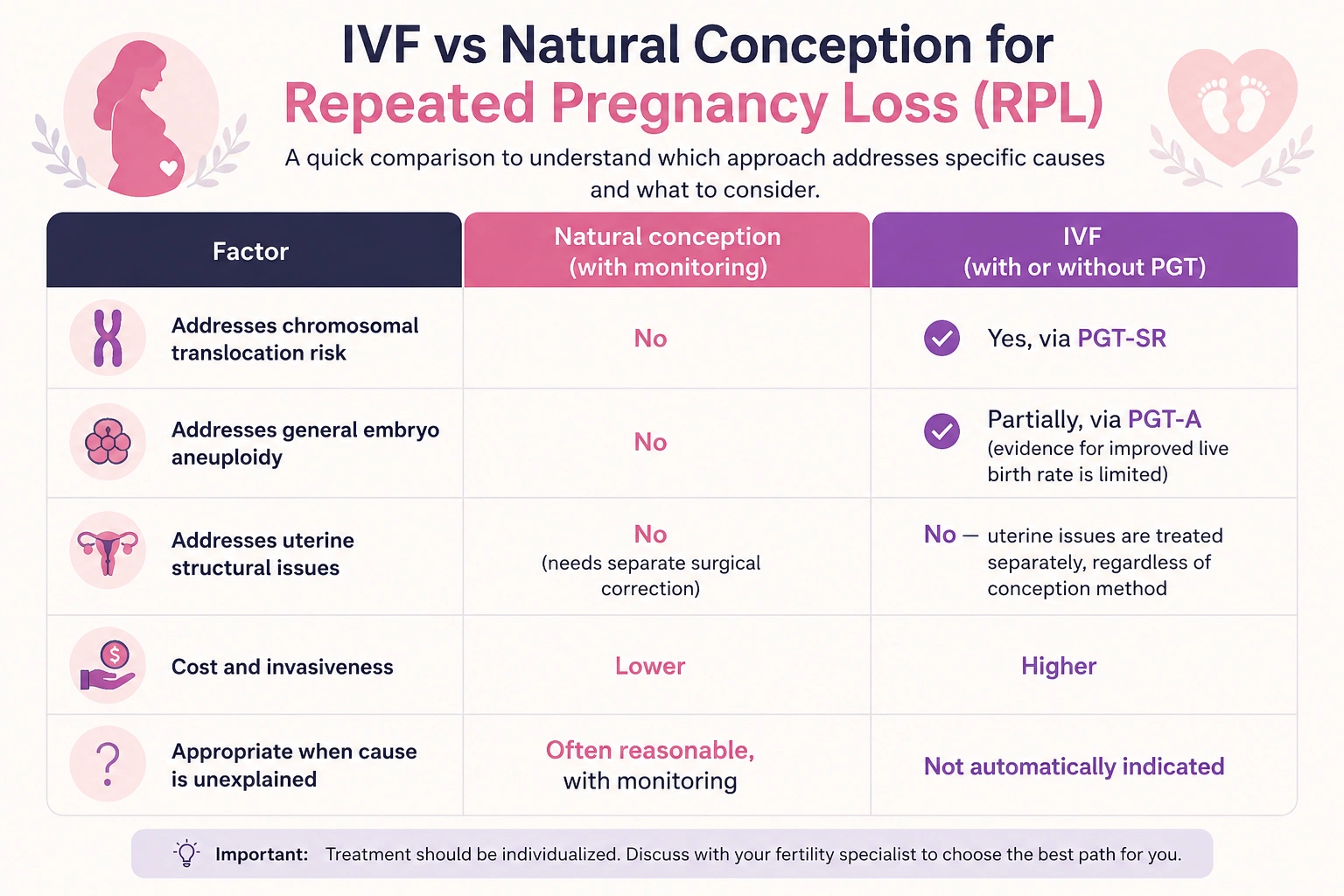
- When a parent carries a balanced chromosomal translocation: IVF with PGT-SR (testing embryos for structural chromosome rearrangements) is a well-established option to select embryos without an unbalanced translocation.
- When RPL is linked to embryo aneuploidy in general (not a known translocation): IVF with PGT-A is sometimes used to try to select chromosomally normal embryos, but evidence supporting this for improving overall live birth rates in RPL specifically remains limited, similar to its uncertain role in general IVF populations.
- When there's significant, irreparable uterine damage: IVF with a gestational carrier may be considered, as noted in ASRM's committee opinion, though this is a major decision requiring detailed counselling.
- When the cause is autoimmune, endocrine, or anatomical: these are usually treated directly (e.g., hysteroscopic correction, thyroid management, aspirin/anticoagulation per specialist guidance) — IVF isn't the primary treatment for these categories.
- When no cause is found (unexplained RPL): many couples in this group go on to have a successful pregnancy with supportive care and monitoring alone, without necessarily needing IVF.
Bottom line: IVF is one tool among several, useful mainly when a specific, IVF-addressable cause is identified — not a default next step for every RPL diagnosis.

AUTHOR

Medically reviewed by Dr. Jay Mehta , MBBS, DNB, Scientific Director, Fertility Specialist—Shree IVF Clinic, Mumbai.
Expert in Reproductive Immunology, Endometriosis, and Advanced IVF
15+ years' experience | 12308+ IVF cycles | 16000+ Endometriosis Surgeries | 2721+ male fertility surgeries
TREATMENT
GET IN TOUCH ON
How IVF is Used to Treat RPL

IVF is a popular assisted reproductive technology (ART) that has shown promise in treating Recurrent Pregnancy Loss (RPL).
The process involves several steps:
- Controlled Ovarian Stimulation
The woman takes fertility medications to stimulate the ovaries and produces multiple mature eggs, increasing the chances of obtaining healthy embryos.
- Egg Retrieval
Mature eggs are collected from the woman's ovaries using a minimally invasive procedure.
- Fertilization
The retrieved eggs are fertilized with sperm in a laboratory, either through conventional insemination or Intracytoplasmic Sperm Injection (ICSI), where a single sperm is injected directly into an egg.
- Embryo Culture
Fertilized eggs are cultured in the laboratory for a few days to develop into embryos.
- Preimplantation Genetic Testing (PGT)
If necessary, PGT can be performed to screen the embryos for chromosomal abnormalities, which is particularly helpful in cases where genetic factors contribute to RPL.
- Embryo Transfer
One or more healthy embryos are transferred into the woman's uterus, with the aim of achieving a successful pregnancy.
You may need to know the Causes of Recurrent Abortion in the First Trimester
We Are Always There For You. Call Us 24/7 For Any Help
Different Types of Treatments Used fo RPL

There are various treatment options available for RPL, depending on the underlying cause.
Some of the most common treatments include:
- Hormone Therapy
Hormonal imbalances can contribute to RPL, and hormone therapy may be used to regulate progesterone or thyroid hormone levels, improving the chances of a successful pregnancy.
- Surgical Interventions
In cases where uterine abnormalities are causing RPL, surgical procedures may be performed to correct the issue.
Examples include hysteroscopy to remove polyps or fibroids, or laparoscopy to treat endometriosis.
- Anticoagulant Therapy
For patients with blood clotting disorders, anticoagulant medications like low-dose aspirin or heparin may be prescribed to reduce the risk of blood clots and improve pregnancy outcomes.
- Immunotherapy
If RPL is caused by immunological factors, treatments such as intravenous immunoglobulin (IVIG) or intralipid infusions may be recommended to modulate the immune system and increase the chances of a successful pregnancy.
- Lifestyle Changes
Modifications in diet, exercise, stress management, and avoiding exposure to harmful substances can also play a role in improving fertility and reducing the risk of RPL.
- Assisted Reproductive Technologies (ART)
In addition to IVF, other ART methods like intrauterine insemination (IUI) or donor eggs/sperm can also be considered for treating RPL in certain cases.
The choice of treatment for RPL will depend on the specific cause and individual circumstances of each couple.
A thorough evaluation by a fertility specialist is essential to determine the most appropriate treatment plan and improve the chances of achieving a successful pregnancy.
You may need to know some tips to make IVF treatment successful
IVF vs Natural Conception for RPL
How Is Repeated Pregnancy Loss Investigated?
- Detailed history of pregnancy losses and any prior test results
- Parental karyotyping to check for balanced translocations
- Pelvic ultrasound or hysteroscopy to assess uterine anatomy
- Antiphospholipid antibody testing
- Thyroid function and blood sugar screening
- Genetic testing of pregnancy tissue from a loss, where feasible, to check for chromosomal cause
- Discussion of findings and a tailored treatment plan — which may or may not include IVF
Benefits and Limitations of IVF for RPL
|
Benefits |
Limitations |
|
Allows PGT-SR for known translocation carriers |
Doesn't fix uterine, autoimmune, or endocrine causes directly |
|
Allows embryo selection when genetic testing is clearly indicated |
Evidence for PGT-A improving live birth rate in general RPL is limited |
|
Can be combined with a gestational carrier for severe uterine cases |
More invasive and costly than monitored natural conception |
|
Gives some patients more information and a sense of control |
Does not guarantee a successful pregnancy or eliminate miscarriage risk |
When Should You See a Specialist?
See a reproductive endocrinologist or gynaecologist if:
- You've had two or more pregnancy losses
- You've had a loss after 12 weeks, which warrants prompt evaluation
- You have known thyroid disease, diabetes, or an autoimmune condition alongside pregnancy loss
- You or your partner have a known chromosomal translocation
Seek urgent care for heavy bleeding, severe pain, fever, or feeling unwell during a suspected or confirmed pregnancy loss — these need timely medical attention regardless of any fertility treatment plans.
A Note on Making This Decision
Repeated pregnancy loss is emotionally difficult, and it's natural to want the most proactive option available. But IVF's value here depends entirely on what your work-up finds — it helps some causes directly, doesn't address others at all, and its benefit for general unexplained RPL is still an active area of research. A specialist in reproductive medicine can walk you through your specific results and what realistically may or may not help.
FAQ
Does IVF reduce the risk of another miscarriage?
Only for specific causes IVF can address, such as a known chromosomal translocation via PGT-SR. For unexplained RPL, evidence that IVF reduces miscarriage risk is limited.
Is genetic testing of embryos (PGT-A) recommended for recurrent pregnancy loss?
It's used in some cases, but current evidence doesn't clearly show it improves overall live birth rates for RPL patients without a specific chromosomal indication like a translocation.
How many miscarriages before I need testing?
Both ASRM and ESHRE generally support starting an evaluation after two pregnancy losses, rather than waiting for three.
Can uterine problems cause repeated pregnancy loss?
Yes — conditions like a septate uterus, fibroids, polyps, or scar tissue are recognised anatomical causes and are usually treated with targeted procedures, not IVF alone.
Does age affect recurrent pregnancy loss risk?
Yes, pregnancy loss risk rises with maternal age, and age is one of the factors specialists weigh when discussing IVF versus other options.
Is IVF guaranteed to result in a successful pregnancy after RPL?
No. IVF can address specific identified causes but does not guarantee a successful pregnancy or eliminate miscarriage risk.
What if no cause is found for my pregnancy losses?
This is common. Many couples with unexplained RPL go on to have a successful pregnancy with supportive monitoring, without IVF being automatically necessary.
Should both partners be tested after recurrent pregnancy loss?
Yes, parental karyotyping and other relevant tests are usually recommended for both partners as part of a thorough evaluation.
AUTHOR
Medically reviewed by Dr. Jay Mehta, MBBS, DNB, Scientific Director, Fertility Specialist—Shree IVF Clinic, Mumbai
Expert in Reproductive Immunology, Endometriosis, and Advanced IVF
15+ years' experience | 12308+ IVF cycles | 16000+ Endometriosis Surgeries | 2721+ male fertility surgeries