

Is Genetic Testing for IVF Worth It?
UPDATED ON 17 AUG. 2026
It depends on your situation. Genetic testing (PGT) can help select embryos without a known chromosomal or single-gene condition, and it's often recommended for specific situations — recurrent miscarriage, advanced maternal age, repeated implantation failure, or a known inherited condition in the family. But for routine use in all IVF patients, the American Society for Reproductive Medicine (ASRM) stated in its 2024 committee opinion that the value of PGT-A as a routine screening test has not been demonstrated. It's a decision to make with your fertility specialist, not a default upgrade everyone needs.
Table of Contents
AUTHOR

Medically reviewed by Dr Jay Mehta, MBBS, DNB
Scientific Director & Fertility Specialist—Shree IVF Clinic, Mumbai
Expert in Reproductive Immunology, Endometriosis, and Advanced IVF
15+ years experience | 12308+ IVF cycles | 16000+ Endometriosis Surgeries | 2721+ male fertility surgeries
TREATMENT
CONDITION
GET IN TOUCH ON
What Is Genetic Testing in IVF?
Preimplantation Genetic Testing (PGT) checks embryos for genetic issues before transfer. There are three main types:
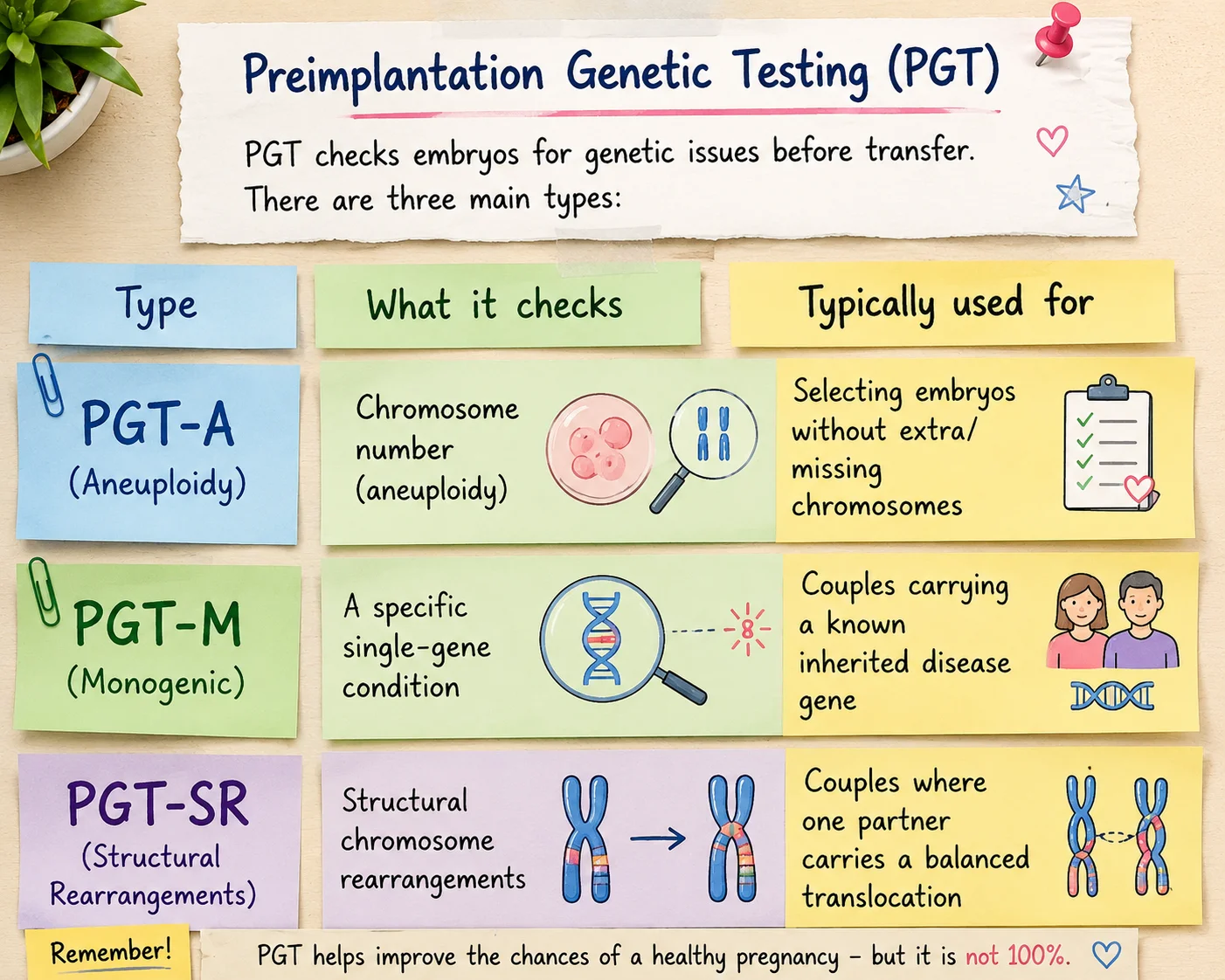
A newer, still-developing test — polygenic embryo screening (PGT-P) — estimates risk for conditions influenced by many genes. ASRM's Ethics and Practice Committees concluded in 2025 that this technology is not ready for clinical use, citing predictive uncertainty.
How Is PGT Done?
- IVF proceeds as usual through egg retrieval and fertilization (typically with ICSI).
- Embryos are cultured to the blastocyst stage (usually day 5–6).
- A small number of cells are biopsied from the outer layer (trophectoderm), not the part that becomes the baby.
- The biopsy is sent to a genetics lab for analysis.
- Embryos are frozen while results are awaited (usually 1–2 weeks).
- Your team discusses which embryo(s), if any, to transfer based on results.
Who Genuinely Benefits From Genetic Testing?
- PGT-M is well established for couples who carry a known single-gene disorder (such as cystic fibrosis or sickle cell disease) and want to avoid passing it on.
- PGT-SR is well established for couples with a known balanced chromosomal translocation, to reduce the chance of an unbalanced embryo.
- PGT-A may be considered case-by-case for recurrent pregnancy loss, repeated implantation failure, advanced maternal age, or when a couple has extra embryos and wants help prioritising which to transfer first.
We Are Always There For You.
Call Us 24/7 For Any Help
Is PGT-A Worth It for Routine, General Use?
-
This is the most searched and most misunderstood part of the topic — and the evidence has shifted recently.
- ASRM's 2024 committee opinion states plainly that PGT-A's value as a routine screening test for all IVF patients has not been demonstrated.
- Two randomized controlled trials (2021 and 2024) found no significant improvement in cumulative live birth rate when comparing PGT-A to standard IVF in good-prognosis patients.
- PGT-A can raise the live birth rate per single embryo transfer, since it screens out embryos less likely to implant — but once embryos discarded due to an abnormal result are accounted for, the overall chance of a live birth per IVF cycle appears similar with or without testing.
- Mosaic embryos (a mix of normal and abnormal cells in the biopsy) add further complexity: research has shown some mosaic-labelled embryos can still result in healthy live births, and ASRM and the Preimplantation Genetic Diagnosis International Society now advise against automatically discarding them.
In short: PGT-A helps you choose between embryos you already have — it doesn't create better embryos, and current evidence doesn't show it reliably increases your overall chance of a baby from a cycle.
Genetic Testing vs No Testing: Quick Comparison
|
Factor |
With PGT-A |
Without PGT-A |
|
Selects likely-euploid embryo for transfer |
Yes |
No (relies on morphology grading) |
|
Proven to raise overall live birth rate per cycle |
Not demonstrated in recent RCTs |
— |
|
Risk of discarding embryos capable of healthy birth (mosaic cases) |
Present, being re-evaluated |
Not applicable |
|
Added cost and time (biopsy, freeze-all, lab analysis) |
Yes |
No |
|
Useful for known genetic/chromosomal conditions |
Yes (PGT-M/PGT-SR) |
Not addressed |
Benefits of Genetic Testing
- Can help identify a known inherited condition before it's passed on (PGT-M, PGT-SR)
- May reduce the number of embryo transfers needed to reach a euploid transfer in select patients
- Provides information some patients find useful for decision-making and emotional preparation
- May reduce miscarriage risk in specific subgroups, though ASRM notes this evidence is unclear and limited
Risks and Limitations
- Biopsy carries a small theoretical risk to the embryo, though current techniques are considered generally safe by reproductive labs
- Mosaic or inconclusive results can complicate decision-making
- A "normal" result doesn't guarantee pregnancy or a healthy baby — it only addresses chromosome number
- Testing adds cost and may delay transfer by a cycle
- Overall live birth rate per IVF cycle has not been shown to improve with routine use
What Does Genetic Testing Cost?
-
Costs vary significantly by clinic, lab, number of embryos tested, and country, and reliable general figures aren't available here. Ask your clinic for an itemised quote covering biopsy, genetic analysis per embryo, and any storage or re-biopsy fees.
When Should You Consider Genetic Testing?
-
Talk to your fertility specialist about PGT if:
- You or your partner carry a known inherited genetic condition
- You or your partner carry a known chromosomal translocation
- You've had two or more pregnancy losses
- You've had repeated implantation failure with good-quality embryos
- You're of advanced maternal age and want help prioritising embryos
- You have several embryos and want a data point (not a guarantee) to help choose
Talking to Your Doctor
-
A useful conversation with your specialist covers:
- Is there a personal or family reason PGT is being recommended for me?
- What would change in my treatment plan based on the result?
- How does your clinic handle mosaic results?
- What are the realistic costs involved at each step?
When Genetic Testing May Not Add Value
- If you have only one or two embryos, since testing doesn't change the biology of those embryos
- If you're using it purely because it's offered as a routine "upgrade" without a specific personal or family indication
- If cost or delay is a major limiting factor and there's no clear medical indication
Genetic testing is a real, evolving area of reproductive medicine — useful and often essential for specific inherited conditions, but not a proven blanket improvement for every IVF patient's overall chance of a baby. The right decision depends on your medical history, family genetics, and how many embryos you have. A qualified reproductive endocrinologist or clinical geneticist can help you weigh this for your specific circumstances.
FAQ
Does genetic testing improve IVF success rates?
Your content goes here. Edit or remove this text inline or in the module Content settings. You can also style every aspect of this content in the module Design settings and even apply custom CSS to this text in the module Advanced settings.
Is PGT-A the same as genetic testing for diseases?
No. PGT-A checks chromosome number only. Testing for specific inherited diseases is called PGT-M, and it's a separate, targeted test.
Can genetic testing harm the embryo?
The biopsy carries a small theoretical risk, but it's considered a well-established technique in experienced IVF labs.
Should I do PGT-A if I'm over 35?
It's often discussed at this age since chromosomal abnormality rates rise, but it's a personal decision to make with your specialist, not an automatic requirement.
What happens if my embryo is labelled "mosaic"?
Mosaic embryos aren't automatically abnormal. Many clinics now consider them for transfer, particularly if no fully euploid embryo is available — this should be discussed with your genetics counsellor or specialist.
Does a "normal" PGT-A result guarantee a healthy baby?
No. It only reflects chromosome number in the tested cells; it doesn't guarantee implantation, ongoing pregnancy, or overall child health.
AUTHOR
Medically reviewed by Dr Jay Mehta, MBBS, DNB
Scientific Director & Fertility Specialist—Shree IVF Clinic, Mumbai
Expert in Reproductive Immunology, Endometriosis, and Advanced IVF
15+ years experience | 12308+ IVF cycles | 16000+ Endometriosis Surgeries | 2721+ male fertility surgeries
TREATMENT
CALL US 24/7 FOR ANY HELP
GET IN TOUCH ON
Recommended Reading