
Can IVF Fail After Successful Implantation?
UPDATED ON 19 AUG , 2026
Table of Contents
Yes — an embryo can implant successfully and a pregnancy can still not continue. Implantation is an early milestone, not a guarantee, and early pregnancy loss can happen whether conception occurred through IVF or naturally. According to the American College of Obstetricians and Gynecologists (ACOG), around 10% of clinically recognized pregnancies end in early loss, and about half of these are linked to chromosomal abnormalities in the embryo — factors related to the embryo itself, not something a patient did or didn't do.
AUTHOR

Medically reviewed by Dr Jay Mehta, MBBS, DNB
Scientific Director & Fertility Specialist—Shree IVF Clinic, Mumbai
Expert in Reproductive Immunology, Endometriosis, and Advanced IVF
15+ years experience | 12308+ IVF cycles | 16000+ Endometriosis Surgeries | 2721+ male fertility surgeries
TREATMENT
CONDITION
Failed IVF
GET IN TOUCH ON
What Does "Implantation" Actually Mean?
Implantation is the process where the embryo attaches to and begins burrowing into the uterine lining (endometrium), typically several days after fertilisation. It's a necessary early step for pregnancy — but it's the beginning of a process, not the end of one. After implantation, the embryo must continue developing correctly, establish a functioning connection with the mother's blood supply, and pass through several more critical stages before a pregnancy is considered established and progressing normally.
How Can IVF "Fail" After Implantation Has Already Happened?
There are two general patterns worth understanding, since they're often confused:
Biochemical Pregnancy
This happens when hCG (the pregnancy hormone) rises enough to register as a positive blood test, showing the embryo did implant, but the pregnancy doesn't progress far enough to be seen on an ultrasound. It's sometimes called a "chemical pregnancy." Biochemical pregnancies are thought to be relatively common — including in natural conception — and most research points to chromosomal abnormalities in the embryo as the leading cause.
Clinical Miscarriage
This is pregnancy loss that occurs after a pregnancy has already been confirmed on ultrasound (for example, after a gestational sac or fetal heartbeat was seen), but before the pregnancy reaches viability. This is a later-stage loss than a biochemical pregnancy and can feel especially difficult, since there was already visual confirmation of the pregnancy.
|
Feature |
Biochemical Pregnancy |
Clinical Miscarriage |
|
How it's identified |
Positive hCG blood test only |
Confirmed on ultrasound, then lost |
|
Typical timing |
Very early, often before or around the expected period |
Later in the first trimester, after ultrasound confirmation |
|
What it confirms |
The embryo implanted and produced hCG |
A gestational sac (and often a heartbeat) had been seen |
|
Emotional context |
Often less clinically visible, but still a real loss |
Often experienced with more attachment, given visual confirmation |
We Are Always There For You.
Call Us 24/7 For Any Help
Why Does This Happen? Common Causes
- Chromosomal abnormalities in the embryo. This is the most frequently cited cause of early pregnancy loss generally. Even embryos that look normal under the microscope, or that were biopsied and appeared chromosomally normal, can occasionally still not develop as expected — biology isn't fully predictable at this stage.
- Uterine or endometrial factors. Conditions like fibroids, polyps, scarring (Asherman's syndrome), or a thin or unreceptive endometrial lining can affect whether an initially implanted embryo can continue developing.
- Hormonal factors. Inadequate progesterone support after transfer, or other hormonal imbalances, can affect the uterine environment needed to sustain early pregnancy.
- Immune and clotting factors. In some cases, conditions affecting blood clotting (thrombophilia) or immune responses are investigated, particularly after repeated early losses — though these are identified in a minority of cases and shouldn't be assumed without testing.
- Maternal age. Chromosomal abnormality rates in embryos rise with maternal age, which is one reason early pregnancy loss becomes more common as women get older.
- Unexplained. In a meaningful proportion of cases, no specific cause is ever identified, even after a full evaluation — which can be one of the hardest parts to sit with.
Does a Biochemical Pregnancy or Early Miscarriage Mean Something Is "Wrong" With Me?
Not necessarily. A single early loss — biochemical or clinical — is common and, on its own, doesn't typically indicate an ongoing fertility problem. In fact, some clinicians view a biochemical pregnancy as a meaningful sign that the embryo was able to implant at all, which is itself useful information about the uterine environment. It's recurrent early loss — generally defined as two or more losses — that more often prompts further investigation into a specific underlying cause.
Read Reviews

5,660+
Google Reviews
Visit Our Channel

421K+
subscribers
Explore more below

245K
followers
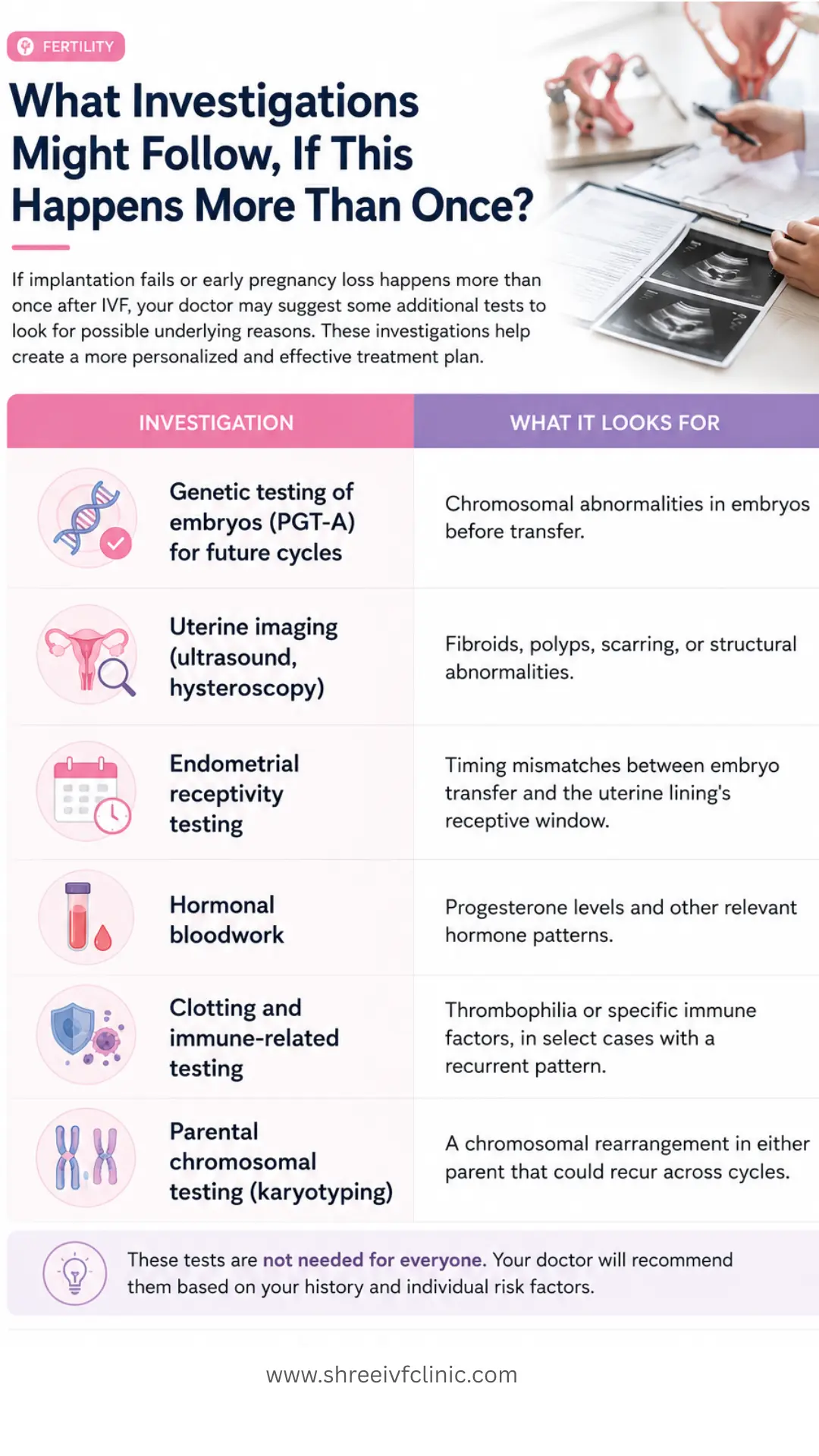
What Investigations Might Follow, If This Happens More Than Once?
How Is a Suspected Early Pregnancy Loss Confirmed?
- Initial blood hCG test, typically 9–14 days after transfer.
- Repeat HCG testing, often 48 hours later, to check whether the level is rising as expected — a slow rise or plateau can be an early signal, though it isn't always definitive on its own.
- Ultrasound, usually scheduled a couple of weeks after a positive blood test, to look for a gestational sac and, once far enough along, cardiac activity.
- Follow-up monitoring, if results are unclear, since early pregnancy dating can sometimes require a repeat scan before a clear picture emerges.
Red Flags: When to Seek Prompt Medical Care
Contact your clinic promptly, rather than waiting, if you experience:
- Heavy vaginal bleeding, more than light spotting
- Severe or one-sided abdominal or pelvic pain
- Shoulder-tip pain, dizziness, or fainting — these can indicate internal bleeding and, uncommonly, an ectopic pregnancy, and need urgent evaluation
- Fever or chills
- Any symptom that feels significantly different or more severe than what you were told to expect
If you're ever unsure whether something warrants a call, it's always reasonable to reach out rather than wait — this is a normal part of early pregnancy monitoring, not something reserved only for emergencies.
Does This Affect the Chances of a Future Successful Pregnancy?
A single early loss after implantation does not necessarily lower your chances in a future cycle, and many people go on to have a successful pregnancy afterward. Some research on recurrent loss has even found that a history of a chromosomally abnormal miscarriage can be associated with reasonably good subsequent live birth rates in later pregnancies, since it points toward an embryo-specific cause rather than an ongoing uterine or maternal issue. That said, every situation is different, and your specialist can give you a more individualised picture based on your specific test results and history.
What Can You Do Differently for a Future Cycle?
- Discuss whether your specific case suggests any value in embryo genetic testing (PGT-A) for future transfers
- Ask whether your protocol — including progesterone support timing and dosage — was appropriate for your situation, or whether adjustments make sense
- If it's happened more than once, ask specifically about a recurrent pregnancy loss work-up rather than simply repeating the same protocol
- Give yourself time to process emotionally before deciding on next steps — there's no medical requirement to rush into another cycle immediately
Frequently Asked Questions
Can an embryo implant and still not result in a pregnancy?
Yes. Implantation is an early step, not a guarantee. The pregnancy can still stop progressing afterward, most often due to a chromosomal abnormality in the embryo.
What is a biochemical pregnancy?
It's a positive hCG blood test that doesn't progress to a pregnancy visible on ultrasound — meaning the embryo implanted and produced hormone, but development didn't continue.
Is a biochemical pregnancy the same as a miscarriage?
They're related but distinct. A biochemical pregnancy is a very early loss identified only through hormone testing; a clinical miscarriage happens after the pregnancy was already confirmed on ultrasound.
What causes early pregnancy loss after IVF?
The most common cause, according to ACOG, is a chromosomal abnormality in the embryo — responsible for roughly half of all early pregnancy losses generally, regardless of how conception happened.
Does a failed implantation after a positive pregnancy test mean something is wrong with me?
Not necessarily. A single early loss is common and often doesn't indicate an ongoing fertility issue; it's a recurrent pattern (generally two or more losses) that typically prompts further investigation.
How is a biochemical pregnancy or early miscarriage confirmed?
Through a blood hCG test, often repeated 48 hours later to check the trend, followed by ultrasound once the pregnancy has progressed far enough to be visible.
Can PGT-A (embryo genetic testing) prevent this from happening again?
It can reduce the chance of transferring a chromosomally abnormal embryo, which is a leading cause of early loss — but it doesn't eliminate all causes of pregnancy loss, since some losses relate to factors PGT-A doesn't test for.
How soon after a positive pregnancy test would I know if something is wrong?
This varies. A slow-rising or plateauing hCG level on repeat testing can be an early signal, but a clearer picture often comes from ultrasound findings over the following weeks.
Should I be tested for blood clotting or immune issues after one early loss?
This is generally considered after a recurrent pattern of loss, not typically after a single occurrence, unless there's a specific reason in your medical history to test sooner.
AUTHOR
Medically reviewed by Dr Jay Mehta, MBBS, DNB
Scientific Director & Fertility Specialist—Shree IVF Clinic, Mumbai
Expert in Reproductive Immunology, Endometriosis, and Advanced IVF
15+ years experience | 12308+ IVF cycles | 16000+ Endometriosis Surgeries | 2721+ male fertility surgeries