
Adenomyosis stages: Is there a Stage 1–4 system?
UPDATED ON 22 AUG. 2026
If you've been diagnosed with adenomyosis, one of your first questions may be, “What stage is my adenomyosis?”
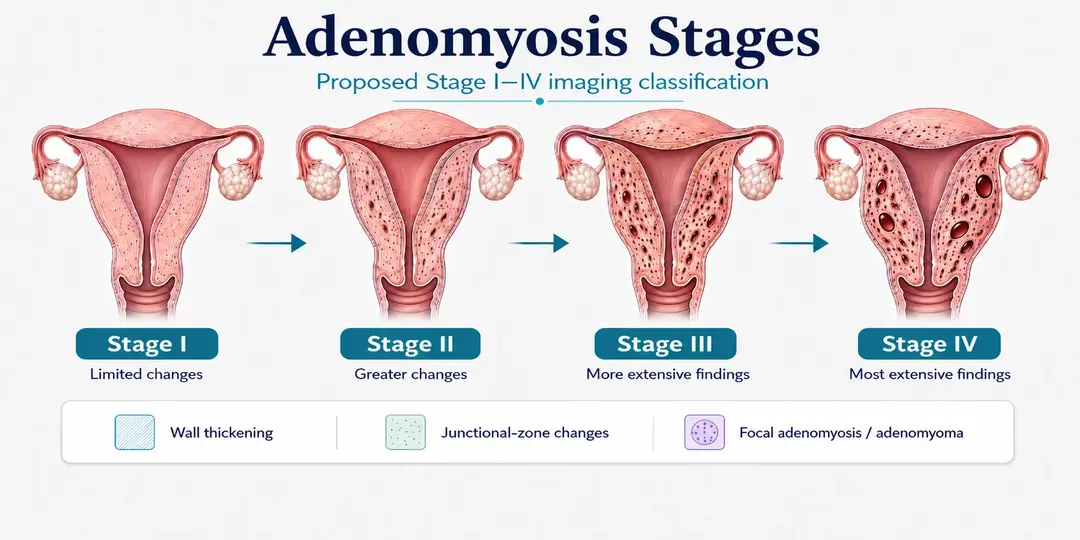
Table of Contents
Is there a Stage 1–4 system for adenomyosis?
Yes, a proposed Stage I–IV imaging classification for adenomyosis was published by the AGCES expert group in 2026. However, it is not yet a universally accepted staging system used in routine clinical practice.
Doctors still commonly describe adenomyosis by where it is located, how much of the uterine muscle is involved, whether it is focal or diffuse, and what the ultrasound or MRI shows.
The AGCES system looks at three areas in imaging:
- Thickening of the uterine wall
- Changes in the junctional zone, the inner part of the uterine muscle next to the womb lining
- Focal adenomyosis or an adenomyoma, a localised mass-like area of adenomyosis
The highest stage found in any of these areas determines the overall AGCES stage.
If your scan says “Stage 3” or “severe adenomyosis,” don't assume the number alone tells you how serious your condition is or what treatment you need. Your symptoms, scan findings, age, fertility plans, and other conditions such as endometriosis or fibroids all matter.
For an overview of how adenomyosis is diagnosed and treated, see our guide to adenomyosis treatment in Mumbai, India.
AUTHOR

Medically reviewed by Dr. Jay Mehta , MBBS, DNB, Scientific Director, Fertility Specialist—Shree IVF Clinic, Mumbai.
Expert in Reproductive Immunology, Endometriosis, and Advanced IVF
15+ years' experience | 12308+ IVF cycles | 16000+ Endometriosis Surgeries | 2721+ male fertility surgeries
TREATMENT
CONDITION
GET IN TOUCH ON
Does adenomyosis have Stage 1, Stage 2, Stage 3 and Stage 4?
Adenomyosis did not historically have one standard Stage 1–4 system, and that has not completely changed in everyday clinical practice.
For many years, doctors described adenomyosis as focal or diffuse, based on where it occurs and how deeply it affects the uterine muscle. They also looked at uterine size, lesion size, junctional-zone changes, and other ultrasound or MRI findings.
The new AGCES framework gives doctors a more structured way to describe the disease. It grades:
- Diffuse uterine-wall thickening
- Diffuse junctional-zone thickening
- Focal adenomyosis or adenomyoma
The highest stage reached in these categories becomes the overall AGCES stage.
This gives specialists a common language, but the stage does not replace clinical judgement. Your doctor still needs to consider your symptoms, fertility plans and the exact location and extent of adenomyosis.
The wider need for consistent classification and diagnosis is also recognised in ESHRE Good Practice Recommendations on Endometriosis.
How do you know what stage of adenomyosis you have?
You can find out the stage of adenomyosis through specialised imaging, such as a transvaginal ultrasound or MRI scan, reviewed by a gynaecologist. The stage is based on specific imaging findings, not symptoms alone.
Key takeaways about adenomyosis stages
- A Stage I–IV system has been proposed, but it is not yet a universally accepted clinical staging system.
- Stage does not equal symptom severity. Someone with Stage II disease can have severe pain, while another person with more extensive imaging findings may have fewer symptoms.
- Focal adenomyosis affects a defined area of the uterine muscle, while diffuse adenomyosis affects a wider area.
- Ultrasound and MRI show where and how adenomyosis affects the uterus. These findings can be more useful than the stage number.
- Mild, moderate and severe are not the same as Stage I, II, III and IV. These terms should not be used interchangeably.
- Adenomyosis may affect fertility, but many women with adenomyosis can become pregnant.
- Adenomyosis does not automatically mean you need IVF or a hysterectomy.
Treatment depends on symptoms, age, disease pattern, fertility plans, and conditions such as endometriosis or fibroids.
- If your scan says “Stage 4” or “severe adenomyosis", discuss the actual imaging findings with a specialist rather than relying on the label alone.
Understanding Adenomyosis Stages
What is Stage 1 adenomyosis?
Stage I is the lowest level of the proposed AGCES imaging classification and reflects more limited changes in imaging.
It may involve limited uterine wall thickening, junctional zone changes, or a smaller focal lesion. However,
Stage 1 does not necessarily mean mild symptoms. Some women with limited imaging changes can have significant period pain, heavy bleeding, or fertility problems.
The stage describes what is seen on imaging. It does not directly measure your pain or quality of life.
What is Stage 2 adenomyosis?
Stage II indicates greater adenomyosis-related changes on imaging than Stage I.
The changes may involve greater thickening of the uterine wall, more prominent junctional-zone changes or a larger focal lesion.
What Stage II means for you depends on where the disease is located, how much of the uterus is affected and whether you are trying to become pregnant.
Two women with Stage II adenomyosis may therefore have very different symptoms and treatment plans.
What is Stage 3 adenomyosis?
Stage III indicates more extensive adenomyosis-related findings on imaging than Stage II.
If your report says “Stage 3 adenomyosis", ask your doctor:
- Which imaging finding produced the Stage III classification?
- Which part of the uterus is affected?
- Is the adenomyosis focal or diffuse?
- How extensive is it?
- Is an adenomyoma present?
- Could the findings affect fertility?
Stage III does not automatically mean you need surgery.
Your treatment should be based on the complete picture rather than the stage number alone.
What is Stage 4 adenomyosis?
Stage IV is the highest category in the proposed AGCES classification and represents the most extensive imaging findings.
It may reflect substantial uterine-wall involvement, extensive junctional-zone changes, or larger focal lesions.
Stage IV deserves careful assessment, but it does not automatically mean hysterectomy is required or that pregnancy is impossible.
Your doctor will consider your age, symptoms, fertility goals, adenomyosis location and extent, and conditions such as endometriosis or fibroids before recommending treatment.
We Are Always There For You.
Call Us 24/7 For Any Help
Is Stage 4 adenomyosis serious?
Stage 4 represents extensive findings on imaging, so it should be assessed properly. But a severe scan does not always mean severe symptoms.
One woman with Stage IV adenomyosis may have manageable symptoms, while another woman with less extensive disease may have severe daily pain or heavy bleeding.
If your report says “Stage 4” or “severe adenomyosis", ask:
- Which walls of the uterus are affected?
- Is the disease focal or diffuse?
- Is there an adenomyoma?
- How much of the uterine muscle is involved?
- What does the junctional zone finding mean?
- Are myometrial cysts present?
- Are fibroids or endometriosis also present?
- Could the disease affect my fertility?
- What uterus-preserving options are available if I want a pregnancy?
The answers to these questions are more useful than the stage number alone.
What is the difference between Stage 1–4 and mild, moderate or severe adenomyosis?
Stage I–IV and mild, moderate, or severe adenomyosis are different ways of describing the condition and should not be treated as equivalent.
The proposed AGCES system uses specific imaging findings to assign a stage.
Older ultrasound descriptions sometimes classified adenomyosis according to the estimated amount of the uterine muscle affected:
- Mild: less than 25%
- Moderate: 25–50%
- Severe: more than 50%
These terms describe the extent of disease, not the same thing as AGCES stages I, II, III, or IV.
So:
Moderate adenomyosis does not automatically mean Stage II.
Severe adenomyosis does not automatically mean Stage IV.
Ask your doctor which classification they are using and what your ultrasound or MRI actually shows.
What does severe adenomyosis mean?
“Severe adenomyosis” is a descriptive term, not a standardised stage with one fixed treatment.
It may refer to extensive changes in the uterine muscle, widespread adenomyosis, significant symptoms or a combination of these.
A severe MRI finding does not automatically mean hysterectomy.
Your specialist will consider:
- Your symptoms
- Uterine size
- Whether the disease is focal or diffuse
- Adenomyoma size and location
- Junctional-zone changes
- Your age
- Previous treatment
- Fertility plans
- Endometriosis or fibroids
Patients often ask whether adenomyosis is dangerous. The answer depends on the individual situation.
Adenomyosis can cause pain, heavy bleeding, and fertility problems in some women, but the diagnosis itself does not mean pregnancy is impossible or that major surgery is necessary.
If endometriosis is suspected as well, it should be assessed separately because the two conditions can affect pain and fertility in different ways.
Shree IVF Clinic provides endometriosis mapping and adenomyosis assessment as part of its diagnostic approach.
What is the difference between focal and diffuse adenomyosis?
Focal adenomyosis affects a defined area of the uterine muscle, while diffuse adenomyosis affects a broader area.
| Feature | Focal adenomyosis | Diffuse adenomyosis |
|---|---|---|
| Distribution | A defined area of the uterine muscle is affected. | A broader area of the uterine muscle is affected. |
| Imaging | May appear as an adenomyoma, a localised mass of adenomyosis. | The uterus may appear enlarged or more globular, with wider changes in the muscle. |
| Treatment planning | The size and location of the affected area are important when choosing treatment. | The overall extent of uterine involvement can make treatment planning more complex. |
| Fertility | In selected cases, uterus-preserving treatment may be considered based on the lesion and fertility goals. | Fertility treatment may require more individualised planning based on the extent of uterine involvement. |
This distinction is particularly important when discussing adenomyosis treatment options or trying to preserve fertility.
Read Reviews

5,660+
Google Reviews
Visit Our Channel

421K+
subscribers
Explore more below

245K
followers
What is focal adenomyosis?
Focal adenomyosis affects one defined area of the uterine muscle and may form an adenomyoma.
If fertility preservation is important, your doctor considers the lesion's:
- Size
- Depth
- Location
- Relationship with the rest of the uterine muscle
Your ovarian reserve, ovulation, fallopian tubes and partner's sperm health also need to be considered rather than treating the adenomyosis by itself.
Selected women with symptomatic focal disease may be assessed for focal adenomyosis treatment, including uterus-preserving approaches when appropriate.
What is diffuse adenomyosis?
Diffuse adenomyosis affects a wider area of the uterine muscle.
It may cause an enlarged or rounded uterus, heavier periods and ongoing pelvic pain.
Diffuse disease does not automatically mean major surgery or that fertility treatment will fail.
Treatment depends on your symptoms, how much of the uterus is affected and whether pregnancy is your current goal.
What does my adenomyosis ultrasound or MRI report mean?
Your actual ultrasound or MRI findings are often more useful than the stage number because they show where and how adenomyosis affects your uterus.
Here are some common terms you may see in your report:
- Focal adenomyosis: Adenomyosis is concentrated in one area.
- Diffuse adenomyosis: Adenomyosis affects a wider area.
- Adenomyoma: A localised, mass-like area of adenomyosis in the uterine muscle.
- Globular uterus: The uterus looks rounded or enlarged.
- Myometrial cysts: Small fluid-filled areas within the uterine muscle.
- Junctional-zone thickening: Changes in the inner layer of the uterine muscle next to the womb lining.
A junctional-zone thickness above 12 mm has traditionally been used as an MRI finding that supports adenomyosis. However, this number should not be used by itself to diagnose adenomyosis. The complete MRI and other findings matter.
The revised MUSA ultrasound approach separates direct features, such as myometrial cysts and hyperechogenic islands, from indirect features, such as a globular uterus, asymmetric muscle thickening, and junctional-zone abnormalities.
Doctors may also assess fan-shaped shadowing and blood flow through the lesion during a transvaginal ultrasound.
For patients who need detailed assessment before treatment or fertility planning, adenomyosis diagnosis and mapping can help identify how the disease is distributed through the uterus.
Current adenomyosis imaging research can also be explored through the NIH PubMed database.
Can adenomyosis get worse over time?
It can become more symptomatic or extensive in some women, but progression is different for everyone.
Adenomyosis is influenced by female hormones and is mainly active during the reproductive years.
Some women develop:
- Increasing period pain
- Heavier periods
- Longer periods
- More persistent pelvic pain
Others may have stable symptoms for years.
Symptoms often improve after menopause when hormone levels fall. However, you should not ignore significant symptoms simply because they may improve later.
Can adenomyosis affect fertility?
Yes. Adenomyosis is associated with reduced fertility and some pregnancy complications in certain women, but many women with adenomyosis can still become pregnant.
Adenomyosis may affect the way the uterus functions through changes in the junctional zone, inflammation, and muscle activity.
A proper fertility assessment should look at:
- Age
- Ovarian reserve
- Ovulation
- Fallopian tubes
- Sperm health
- Endometriosis
- Fibroids
- Location and extent of adenomyosis
This is why a fertility evaluation should look at the whole reproductive picture rather than focusing only on the adenomyosis stage.
This approach is also consistent with ASRM guidance on fertility evaluation.
Can I get pregnant with adenomyosis?
Yes. Pregnancy is possible with adenomyosis, both naturally and with fertility treatment.
The stage alone cannot tell you whether you will become pregnant.
Your chances depend on factors such as:
- Age
- Ovarian reserve
- Ovulation
- Sperm parameters
- Fallopian-tube function
- Location and extent of adenomyosis
- Endometriosis or other reproductive conditions
So, “Can I get pregnant with Stage 3 or Stage 4 adenomyosis?” cannot be answered from the stage number alone.
At Shree IVF Clinic, fertility assessment and adenomyosis treatment can be planned together when pregnancy is a goal.
Does adenomyosis affect IVF success?
It may affect IVF outcomes in some women, but the effect is not the same for everyone.
Research has linked adenomyosis with lower reproductive outcomes in some IVF patients. However, researchers are still studying which patients may benefit from treatment before IVF.
Doctors may consider:
- Uterine size
- Junctional-zone changes
- Adenomyosis distribution
- Previous IVF results
- Age
- Ovarian reserve
- Other fertility factors
There is currently no single treatment-before-IVF plan that is right for every woman.
If IVF is being considered, IVF treatment and fertility care can be planned alongside assessment of adenomyosis and other fertility factors.
For women with previous unsuccessful IVF cycles, doctors may also consider whether recurrent implantation failure evaluation is appropriate.
How is adenomyosis treated?
Adenomyosis treatment depends on your symptoms, scan findings, age, and fertility plans—not simply the stage.
Your doctor may consider:
- Observation if symptoms are mild
- Medicines for pain or heavy bleeding
- Hormonal treatment when pregnancy is not the immediate goal
- Fertility planning
- Selected uterus-preserving procedures
- Surgery in carefully selected cases
- Hysterectomy for women who have completed their families and need definitive treatment
There is no single treatment that works for every woman.
See our detailed guide to adenomyosis treatment in India for an overview of medical and surgical options.
How is focal adenomyosis treated?
Some women with symptomatic focal adenomyosis may be considered for adenomyomectomy, a surgery that removes the affected area while keeping the uterus.
Treatment decisions depend on:
- Lesion size
- Depth
- Location
- Remaining healthy uterine muscle
- Symptoms
- Fertility plans
In selected patients, microwave ablation for adenomyosis may also be considered as a uterus-preserving treatment option.
These procedures are not suitable for everyone. Fertility-sparing treatment should be planned individually after detailed imaging and specialist assessment.
How is diffuse adenomyosis treated?
Diffuse adenomyosis is treated according to symptoms, disease extent and whether pregnancy is desired.
Medicines and hormonal treatment may help control symptoms when pregnancy is not the immediate goal.
Women trying to conceive may need a fertility-focused treatment plan.
For women who have completed their families and continue to have severe symptoms despite other treatments, hysterectomy is the definitive treatment.
Shree IVF Clinic provides laparoscopic and advanced gynaecological surgery when surgery is appropriate for selected patients.
What should I do if my scan says “severe adenomyosis”?
Don't make treatment decisions based on the word “severe” alone. Get the scan reviewed by a specialist who can connect the imaging findings with your symptoms and fertility goals.
Take your ultrasound or MRI report to the appointment and ask:
- Is my adenomyosis focal, diffuse, or mixed?
- Which walls of my uterus are affected?
- How extensive is the disease?
- Is an adenomyoma present?
- What does my junctional-zone measurement mean?
- Are myometrial cysts present?
- Do I also have endometriosis or fibroids?
- Could adenomyosis affect my fertility?
- Should treatment be considered before trying to conceive?
- What uterus-preserving options are realistic for me?
These answers are much more useful than simply asking “What stage am I?”
When should I see an adenomyosis specialist in Mumbai?
You should consider specialist evaluation if your symptoms are severe, worsening, or affecting fertility or daily life.
See a gynaecologist or fertility specialist if you have:
- Severe or worsening period pain
- Very heavy or prolonged periods
- Pelvic pain between periods
- Pain during sex
- An enlarged or tender uterus
- Difficulty conceiving
- Repeated pregnancy loss
- An ultrasound or MRI showing adenomyosis
- Symptoms that have not improved with previous treatment
If you're looking for an adenomyosis specialist in Mumbai, choose someone who can review your ultrasound or MRI together with your symptoms and fertility goals.
At Shree IVF Clinic in Mumbai, Dr Jay Mehta can review your imaging, symptoms, and fertility goals and explain what the findings may mean for your treatment and reproductive plans.
Book an appointment: 1800-268-4000. Get personalised guidance on your adenomyosis diagnosis and treatment options
Adenomyosis stages: What should patients remember?
Adenomyosis now has a proposed AGCES Stage I–IV imaging classification, but it is not yet a universally adopted staging system in routine clinical practice.
The stage number is only one part of the assessment.
The more useful questions are:
- Where is the adenomyosis?
- Is it focal or diffuse?
- How much of the uterus is affected?
- What does the ultrasound or MRI actually show?
- Is an adenomyoma present?
- Is endometriosis also present?
- Could adenomyosis affect fertility?
- What treatment fits your goals?
If you're seeking assessment in Mumbai or elsewhere in India, your scan report is the starting point—not the final treatment decision.
At Shree IVF Clinic, you can discuss your scan findings, symptoms, and fertility goals with a specialist.
FAQ's about adenomyosis stages
Is there a Stage 1, 2, 3 or 4 for adenomyosis?
The AGCES expert consensus proposes an imaging-based Stage I–IV classification. It is an emerging framework and is not yet universally adopted in routine clinical practice.
Can adenomyosis cause infertility?
Adenomyosis is associated with reduced fertility in some women, but pregnancy remains possible. Age, ovarian reserve, tubal function, sperm factors, endometriosis and adenomyosis characteristics all matter.
Can I get pregnant with Stage 4 adenomyosis?
Yes, pregnancy may still be possible. Your individual fertility outlook depends on the complete reproductive picture rather than the stage number alone.
Do I need IVF if I have adenomyosis?
No. Adenomyosis does not automatically mean you need IVF. A fertility specialist should assess your age, ovarian reserve, ovulation, tubes, sperm factors, and adenomyosis before recommending treatment.
Can adenomyosis be treated without a hysterectomy?
Yes. Medicines, hormonal treatment and selected uterus-preserving procedures may be options depending on symptoms, disease characteristics and fertility goals.
How do doctors assess how extensive adenomyosis is?
Doctors combine symptoms and examination with transvaginal ultrasound and, when needed, MRI. They assess the location, pattern, depth, lesion size, junctional zone and other imaging findings.
What causes adenomyosis?
The exact cause is not fully understood. Our adenomyosis treatment and patient guide explains the condition, diagnosis, types, and available treatment approaches.
How can I find an adenomyosis specialist in Mumbai?
Look for a gynaecologist or fertility specialist who has experience assessing adenomyosis using detailed ultrasound or MRI and can consider your symptoms and fertility goals together. Take your previous scan reports and treatment history to the consultation.
AUTHOR
Medically reviewed by Dr. Jay Mehta, MBBS, DNB, Scientific Director, Fertility Specialist—Shree IVF Clinic, Mumbai
Expert in Reproductive Immunology, Endometriosis, and Advanced IVF
15+ years' experience | 12308+ IVF cycles | 16000+ Endometriosis Surgeries | 2721+ male fertility surgeries