
Home » Blogs » IUI vs. IVF Pain

IUI vs IVF: Which is More Painful?

UPDATED ON 14TH AUG. 2026

Table of Contents

IVF generally involves more discomfort than IUI, mainly because of the daily hormone injections during ovarian stimulation and the egg retrieval procedure, which is done under sedation precisely because it would otherwise be painful. 

IUI itself is usually described as quick and largely painless, similar to a Pap smear, with at most mild cramping. Neither treatment is pain-free from start to finish, but the type, timing, and intensity of discomfort differ quite a bit between the two.

IU vs IVF Pain

AUTHOR

Medically reviewed by Dr Jay Mehta,  MBBS, DNB
Scientific Director & Fertility Specialist—Shree IVF Clinic, Mumbai

Expert in Reproductive Immunology, Endometriosis, and Advanced IVF

15+ years experience | 12308+ IVF cycles | 16000+ Endometriosis Surgeries | 2721+ male fertility surgeries

TREATMENT

IUI
IVF

CONDITION

Infertility

GET IN TOUCH ON

Quick Answer

IUI is typically the less painful of the two treatments. The insemination procedure itself takes just a few minutes and is usually described as similar to a Pap smear — a brief pinching sensation and mild cramping, according to patient education materials from the American Society for Reproductive Medicine (ASRM). 

IVF involves more potential discomfort overall: daily injections during stimulation, bloating from enlarged ovaries, and the egg retrieval procedure itself, which studies describe as a genuinely painful procedure if performed without anesthesia — which is why sedation or a local anesthetic block is routinely used. Embryo transfer in IVF, by contrast, feels similar to IUI. Pain tolerance and individual anatomy affect how each person actually experiences either treatment.

What Is IUI, and What Does It Involve?

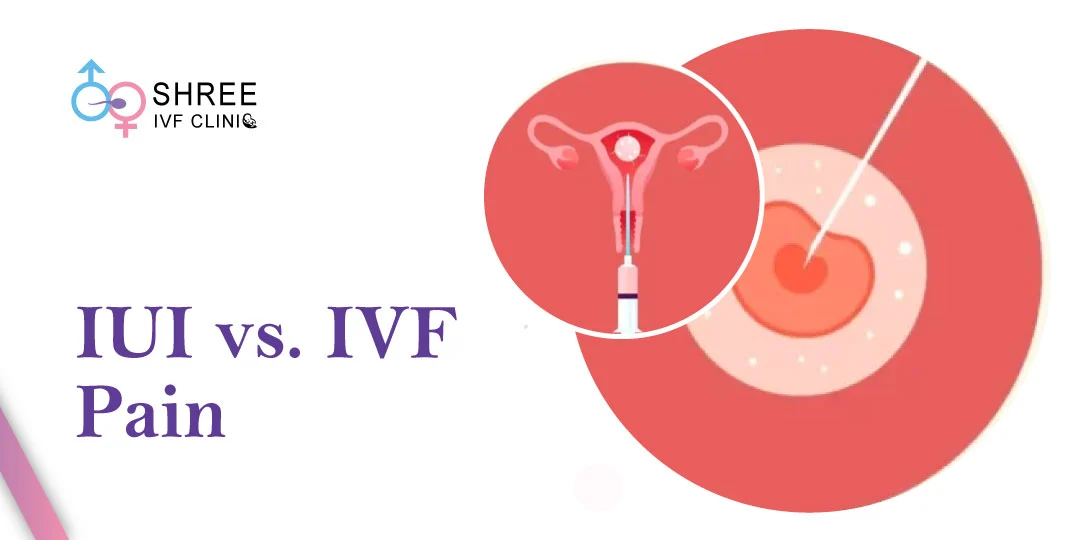
Intrauterine insemination (IUI) is a fertility procedure where prepared (washed) sperm is placed directly into the uterus using a thin catheter, timed around ovulation.

According to ASRM, the actual insemination is usually painless, though some women feel mild cramping as the catheter passes through the cervix.

We Are Always There For You.
Call Us 24/7 For Any Help

What Is IVF, and What Does It Involve?

In vitro fertilisation (IVF) is a multi-step process: ovarian stimulation with injectable hormones, egg retrieval, fertilisation in the lab, embryo culture, and embryo transfer. Unlike IUI, IVF involves a surgical step — egg retrieval — that requires sedation or anesthesia specifically because the procedure would otherwise cause significant pain.

IUI vs IVF: Pain Comparison by Step

Step IUI IVF
Stimulation Mild medicines; usually little discomfort Daily injections for ~8–14 days; may cause bloating or soreness
Monitoring Occasional scans and blood tests More frequent scans and blood tests
Main Procedure Quick insemination; usually mild or no discomfort Egg retrieval under sedation/anesthesia; mild cramping may follow
Recovery Usually little to none; normal activities often resume the same day Rest is commonly advised for the remainder of the day
Embryo Transfer Not applicable Brief procedure, usually similar to IUI with mild discomfort


Is IUI Painful?

For most people, no — not in any significant way. ASRM's patient education materials describe the procedure as usually painless, sometimes with a slight pinching sensation and mild cramping as the catheter passes through the cervix. The entire insemination step takes only a few minutes. If ovulation-inducing medication is used beforehand, some patients report mild side effects like bloating or headache, but this is generally not described as painful.

Some patients report more cramping if the semen sample requires more manipulation or if there's cervical stenosis (narrowing), which can make catheter passage slightly more uncomfortable — but this isn't the typical experience.

Is IVF Painful?

IVF has more potential points of discomfort than IUI, spread across a longer process:

During Ovarian Stimulation

Daily injections are the most consistent source of discomfort during this phase. Most patients describe the injections themselves as a brief pinch, but as stimulation continues, growing ovarian follicles can cause bloating, pelvic heaviness, or mild-to-moderate discomfort — particularly toward the end of the stimulation phase.

During Egg Retrieval

This is the step most directly associated with pain in the clinical literature. A review published on PubMed Central describes transvaginal oocyte retrieval as a painful procedure, caused by the aspiration needle puncturing the vaginal wall and ovarian tissue repeatedly to reach each follicle.

This is exactly why sedation or anesthesia is considered a standard part of the procedure rather than optional — a U.S. survey of IVF programs found that essentially all responding clinics used some form of IV sedation for retrieval, according to research published in Fertility and Sterility. Multiple approaches are used, including conscious sedation, general anesthesia, or a local paracervical block, sometimes combined with sedation.

After Egg Retrieval

Mild cramping, bloating, and spotting are common in the hours after retrieval, and most clinics recommend rest for the remainder of the day. Over-the-counter pain relief is often sufficient, though your clinic will advise on what's appropriate.

During Embryo Transfer

This step is not typically painful. It's technically similar to an IUI procedure or a Pap smear — a catheter is passed through the cervix to place the embryo into the uterus — and sedation is not usually required.

Why Is Egg Retrieval More Painful Than Insemination?

The core difference comes down to what's physically happening. IUI involves passing a soft catheter through the cervix — a passage the body is naturally built to accommodate. Egg retrieval involves a needle passing through the vaginal wall and into ovarian tissue multiple times to reach each follicle, which is a more invasive process. That's the direct reason IVF requires sedation as a standard part of care, while IUI does not.

How Is Pain Managed During Each Procedure?

IUI vs IVF
  1. Individual Pain Tolerance: Just like some people cry over a papercut while others barely flinch, everyone’s pain tolerance is different.
  2. Medical Expertise: A skilled doctor can make both procedures smoother and less painful.
  3. Emotional Factors: Anxiety or fear can make any sensation feel worse. A calm and supportive environment helps reduce perceived pain.

Does Pain During Egg Retrieval Affect IVF Success?

No strong evidence suggests that the type of anesthesia used affects pregnancy or live birth outcomes. Research comparing anesthesia approaches, including a review of studies on propofol, alfentanil, and lidocaine, has generally not found meaningful differences in reproductive outcomes tied to the anesthetic method chosen. The choice of technique is mainly about patient comfort and safety, not about which method gives better IVF results.

Read Reviews

google-logo

5,660+

Google Reviews

Visit Our Channel

youtube-icon

421K+

subscribers

Explore more below

instagram-icon

245K

followers

IUI vs IVF Factors That Can Make Either Procedure More or Less Uncomfortable

  • Pain tolerance and anxiety levels — vary significantly between individuals
  • Cervical anatomy — a tilted uterus or cervical stenosis can make catheter placement slightly harder for both IUI and embryo transfer
  • Number of follicles/eggs retrieved — more follicles generally means a longer retrieval procedure
  • Underlying conditions — conditions like endometriosis or adenomyosis have been associated with more pelvic sensitivity, which can affect the retrieval experience specifically
  • Experience of the clinical team — technique and skill can influence both speed and comfort

What Can You Do to Reduce Pain?

For IUI:

    • Relax during the procedure. Taking deep breaths can help.
    • Take a mild pain reliever if your doctor recommends it.

For IVF:

    • Stay hydrated to ease bloating from medications.
    • Use a heating pad for any soreness after egg retrieval.

Final Words

Both IUI and IVF are paths to the same goal: helping you build your family. While pain is a part of the process, it’s temporary and well-managed by your medical team. Focus on the bigger picture—a healthy baby—and know that you’re not alone in this journey.

For any concerns you may have, feel free to consult with our fertility expert, Dr. Jay Mehta, and his team. They are committed to making your experience as pleasant and comfortable as possible

FAQ

What does egg retrieval feel like afterward?

Mild cramping, bloating, and light spotting are common in the hours and day after retrieval. This usually improves within a day or two, though your clinic can advise if symptoms feel unusual.

Are IVF injections painful?

 Most patients describe the injections as a brief pinch rather than significant pain, though injection-site bruising and soreness can build up over the stimulation period.

Is embryo transfer as painful as egg retrieval?

No. Embryo transfer is generally similar in sensation to IUI or a Pap smear and doesn't typically require sedation, unlike egg retrieval.

Can I request more pain relief during IVF egg retrieval?

Yes — this is worth discussing directly with your fertility team beforehand, since several anesthesia and sedation approaches are available, and your comfort and any prior experience can guide the choice.

Does pain level affect whether IUI or IVF will work?

No. Pain and discomfort during either procedure are not linked to whether the treatment succeeds; success depends on factors like the underlying fertility diagnosis, egg and sperm quality, and uterine receptivity

Is IUI painful if I have a tilted uterus?

It can occasionally be slightly more uncomfortable, since catheter placement may need extra care, but it's usually still manageable and brief.

Does having endometriosis make egg retrieval more painful?

Some studies associate conditions like endometriosis with increased pelvic sensitivity, which may affect the retrieval experience for some patients. Discuss any known condition with your fertility team so they can plan accordingly.

Is IUI more painful than a Pap smear?

Some studies associate conditions like endometriosis with increased pelvic sensitivity, which may affect the retrieval experience for some patients. Discuss any known condition with your fertility team so they can plan accordingly.

AUTHOR

Medically reviewed by Dr Jay Mehta,  MBBS, DNB
Scientific Director & Fertility Specialist—Shree IVF Clinic, Mumbai

Expert in Reproductive Immunology, Endometriosis, and Advanced IVF

15+ years experience | 12308+ IVF cycles | 16000+ Endometriosis Surgeries | 2721+ male fertility surgeries

TREATMENT

IVF

IUI

CALL US 24/7 FOR ANY HELP

GET IN TOUCH ON