

How Do I Choose the Right Gynaecologist for My Needs?
UPDATED ON 22 JULY 2026
Choosing the right gynecologist depends on your specific health concern.
For routine care such as annual check-ups, contraception, cervical screening, or common menstrual issues, a general gynecologist may be suitable.
However, conditions like infertility, endometriosis, recurrent miscarriage, PMOS (PCOS), hormonal disorders, or complex pelvic conditions require a specialist with focused expertise in that area.
Rather than choosing based only on location, online ratings, or hospital reputation, look for a gynaecologist whose expertise matches your specific medical needs.
The right specialist is more likely to provide an accurate diagnosis, personalised treatment, and better long-term outcomes.

AUTHOR

Medically reviewed by Dr Jay Mehta, MBBS, DNB
Scientific Director & Fertility Specialist—Shree IVF Clinic, Mumbai
Expert in Reproductive Immunology, Endometriosis, and Advanced IVF
15+ years experience | 12308+ IVF cycles | 16000+ Endometriosis Surgeries | 2721+ male fertility surgeries
CONDITION
GET IN TOUCH ON
To choose the right gynecologist:
- Match the doctor's expertise to your condition.
- Verify qualifications and subspecialty training.
- Check experience treating patients with similar conditions.
- Evaluate communication style and treatment approach.
- Confirm hospital infrastructure and diagnostic facilities.
- Read patient reviews critically.
- Choose a doctor you trust and feel comfortable with.
Mumbai offers excellent women's healthcare across general gynaecology clinics, maternity hospitals, fertility centres, endometriosis clinics, and tertiary referral hospitals.
The key is not finding a gynaecologist but finding the right specialist for your condition.
We Are Always There For You.
Call Us 24/7 For Any Help
Gynaecologist vs Obstetrician vs OB-GYN
Many women use these terms interchangeably. They refer to different roles.
A gynecologist diagnoses and treats conditions affecting the female reproductive system outside of pregnancy.
An obstetrician specialises in pregnancy, labour, childbirth, and postnatal care.
In India, most practicing specialists are trained as obstetrician-gynaecologists (OB-GYNs), meaning they provide both.
| Feature | Gynaecologist | Obstetrician | OB-GYN (Combined) |
|---|---|---|---|
| Primary focus | Women's reproductive health outside pregnancy | Pregnancy, labour, childbirth, and postnatal care | Provides both gynaecological and obstetric care |
| Best for | Menstrual disorders, PCOS, fibroids, ovarian cysts, contraception, menopause, cervical screening | Pregnancy planning, antenatal care, labour, delivery, and postpartum care | Most routine women's healthcare and pregnancy-related needs |
| Delivers babies | No | Yes | Yes |
| Basic fertility assessment | Yes | No | Yes |
| Provides IVF treatment | No | No | No—IVF requires a dedicated Fertility Specialist (reproductive medicine specialist). |
| Most common in Mumbai | Less common as a standalone | Less common as a standalone | Most practicing specialists are trained as OB-GYNs. |
Important: If you are planning IVF or have difficulty conceiving, look specifically for a fertility specialist (reproductive medicine specialist), not just an OB-GYN.
Many OB-GYNs perform basic fertility evaluations, but advanced fertility treatment requires specific training, certification, and infrastructure.
Choose the Right Gynaecologist Based on Your Health Concern
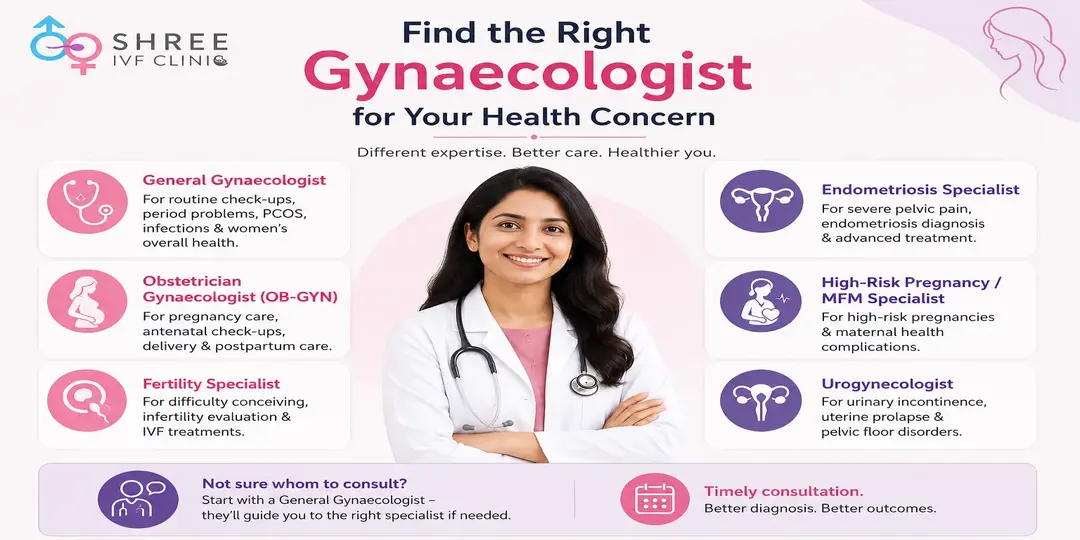
Not all gynaecologists manage the same conditions. Use this table to match your concern to the right specialist.
| Your Health Concern | Right Specialist to Consult | When to Seek This Specialist |
|---|---|---|
| Routine women's healthcare | General Gynaecologist | Annual check-ups, cervical screening, HPV vaccination, contraception, routine menstrual concerns |
| Pregnancy planning and routine pregnancy care | Obstetrician-Gynaecologist (OB-GYN) | Pregnancy confirmation, antenatal care, delivery planning |
| High-risk pregnancy | Maternal-Foetal Medicine (MFM) Specialist | Twin pregnancy, IVF pregnancy, diabetes, hypertension, previous preterm birth, or maternal medical conditions |
| Heavy or irregular periods | General Gynaecologist or Gynaecological Endocrinologist | Persistent abnormal bleeding, severe menstrual pain, or symptoms requiring further evaluation. |
| PCOS and hormonal disorders | PCOS Specialist or Reproductive Endocrinologist | Irregular ovulation, insulin resistance, fertility concerns, or long-term hormonal management |
| Menopause and hormonal changes | Gynaecologist with Menopause Expertise | Hot flushes, perimenopause, menopause management, or hormone replacement therapy |
| Pelvic pain or suspected endometriosis | Endometriosis Specialist | Severe period pain, painful intercourse, chronic pelvic pain, or suspected endometrioma |
| Deep or complex endometriosis | High-Volume Endometriosis Surgeon | Bowel, bladder, diaphragm, or extensive pelvic involvement requiring advanced surgery |
| Ovarian cysts affecting fertility | Fertility-Preserving Gynaecological Surgeon | Endometrioma or ovarian cyst requiring fertility-preserving management |
| Urinary leakage or pelvic floor disorders | Urogynaecologist | Urinary incontinence, pelvic organ prolapse, or pelvic floor dysfunction |
| Difficulty conceiving | Fertility Specialist (Reproductive Medicine Specialist) | Trying to conceive for 12 months (under 35) or 6 months (35 or older) without success |
| Known fertility problems | Fertility Specialist | Low AMH, blocked fallopian tubes, PCOS-related infertility, male factor infertility, or endometriosis |
| Recurrent miscarriage | Reproductive Medicine Specialist or Recurrent Pregnancy Loss Specialist | Two or more pregnancy losses requiring detailed investigation |
| Repeated IVF failure | IVF Specialist with Advanced Fertility Expertise | Failed embryo transfers or unsuccessful IVF cycles despite good-quality embryos |
| Abnormal Pap smear or suspected gynaecological cancer | Gynaecologic Oncologist | Abnormal cervical screening, ovarian, uterine, cervical, vulval, or other suspected gynaecological cancers |
What Happens During Your First Gynaecology Appointment?
Knowing what to expect removes the most common barrier to booking. Here is what a first gynaecological consultation typically involves:
1. Medical history
Your doctor will ask about your menstrual cycle, contraception, previous pregnancies, prior surgeries, family history, and current symptoms. Prepare to answer honestly — this directly shapes the quality of care you receive.
2. Physical examination (if clinically indicated)
Depending on your reason for attending, this may include a pelvic examination, breast examination, or both. You can decline any examination you are uncomfortable with.
A good clinician will explain what is involved before proceeding and will not proceed without your consent.
3. Investigation requests
Based on your history, your doctor may order blood tests (hormone panel, thyroid, blood count), an ultrasound, a cervical smear, or other investigations. These typically happen at a follow-up appointment — not the same day.
4. Discussion and next steps
Your doctor explains their initial assessment, orders investigations, and outlines what happens next. A good first appointment ends with clear next steps, not vague reassurance.
What to bring:
- Previous test reports, scan results, or prescriptions
- A written list of your symptoms with approximate dates
- Current medications (name and dosage)
- Questions written down in advance
How long does it take? First appointments typically run 20–30 minutes. Follow-up appointments are shorter. Surgical consultations or complex fertility evaluations may take longer.
Based on our clinical experience, many patients who come to our centre after years of unsuccessful treatment have not necessarily received incorrect care but may not have been matched with a specialist focused on their specific condition.
— Dr. Jay Mehta, Scientific Director, Shree IVF Clinic, Mumbai
Read Reviews

5,660+
Google Reviews
Visit Our Channel

421K+
subscribers
Explore more below

245K
followers
Female vs. Male Gynaecologist: Which Is Better?
This is one of the most commonly asked questions and a completely legitimate one.
Clinically, there is no evidence that a female gynecologist produces better patient outcomes than a male one, or vice versa.
Outcomes are driven by diagnostic accuracy, clinical volume, and treatment approach — not gender.
That said, comfort during examination is a clinical factor. If discomfort causes you to delay seeking care, withhold symptoms, or disengage from treatment, that directly affects your health.
If you have a strong preference for a female doctor, choose a female doctor. That preference is valid and does not require justification.
What matters most regardless of gender:
- Do you feel comfortable discussing symptoms without filtering what you say?
- Does the doctor listen without interrupting or dismissing your concerns?
- Do you trust the clinical reasoning being applied to your case?
- Are examinations conducted with clear explanation and your consent?
These factors predict your engagement with care and your treatment outcomes more reliably than any demographic feature of the clinician.
Practical note: Many specialist gynaecology clinics in Mumbai have both male and female consultants.
If a preference matters to you, confirm availability when booking rather than assuming.
📞For urgent gynaecological concerns in Mumbai: 1800-268-4000 | WhatsApp
Should You Book an Online or In-Person Consultation?
Most gynaecology clinics now offer teleconsultation. Online appointments are appropriate for:
- Initial symptom discussion before deciding whether to come in
- Review of existing test results, scan reports, or prescriptions
- Second opinion on a diagnosis or proposed treatment plan
- Follow-up appointments when your situation is stable and no examination is needed
Online consultations are not a replacement for physical examination.
Any presentation requiring a pelvic examination, transvaginal ultrasound, or surgical assessment requires an in-person visit.
Think of an online appointment as a useful first step; it helps you determine whether the specialist is a good fit before committing to an in-person consultation, and it saves travel time for straightforward follow-ups.
📞 Book an online consultation with Dr. Jay Mehta: 1800-268-4000 | WhatsApp
How to Evaluate a Gynaecologist Before Booking?
Qualifications and subspecialty training tell you a doctor is equipped for the clinical work. These qualities tell you they will actually use that training well.
- Diagnostic discipline. They investigate before they treat. No significant clinical recommendation is made without a completed workup specific to your presentation. Treatment preceded by incomplete investigation is a process failure, regardless of the outcome.
- Clear communication. They explain what they found, what it means for you, and why the proposed course of action is appropriate. Technical terms are explained, not used as a substitute for explanation.
- Realistic prognosis. They give honest probability ranges, not only reassurance. A good gynaecologist tells you what a treatment is likely to achieve, including its limitations and the scenarios in which it may not work.
- Continuity of care. You see the same doctor across appointments, or a clearly named team member is responsible for your care between consultations. You are not repeating your history to a different person at every visit.
- Willingness to refer. A good specialist knows where their own expertise ends. If your condition sits outside their scope, they refer rather than proceeding regardless.
- Support for second opinions. They do not discourage independent review of significant recommendations. A clinician confident in their assessment supports your right to verify it.
- Evidence-based practice. Their clinical approach is grounded in current guidelines and published evidence, not exclusively in habit, institutional preference, or the techniques they are most familiar with.
- Clear next steps after every appointment. You leave with specific tests ordered, a follow-up date, and a summary of what happens next.
Pre-Booking Checklist for Choosing a Gynaecologist
Use this before you confirm any appointment.
- Their subspecialty matches my condition, not just "gynaecologist"
- I know who will manage my day-to-day care, not just who I met at consultation
- They investigate before they treat
- I've asked what happens if the first treatment doesn't work
- I understand why this treatment is right for my specific situation, not just what it is
- I can reach the team between appointments if something changes
- Qualifications confirmed: MBBS + MD/MS minimum; fellowship training for subspecialty conditions
- I know what is included in the first appointment fee and what costs extra
- I am comfortable asking questions without feeling rushed or dismissed
- For complex conditions: I've verified the doctor's caseload volume in my specific condition
When Should You Consider Changing Your Gynaecologist?
Consider changing your gynaecologist if:
- Two or more treatments have failed with no protocol review and no explanation offered
- Your questions are dismissed, minimised, or left unanswered
- You have a diagnosis that doesn't clearly explain your symptoms or no diagnosis after a reasonable investigation period
- A major recommendation (surgery, donor eggs, stopping treatment) was made without full investigation or discussion of alternatives
- You cannot reliably reach the team between appointments when something changes
- You have lost confidence in the clinical reasoning being applied to your case
What changing actually looks like in practice:
You own your medical records and can request them at any time; this is your legal right.
A new specialist reviews your existing records; you do not start from zero, and recent investigations that are still clinically relevant do not need to be repeated.
A second opinion is a clinical right, not a sign of disloyalty. For any recommendation involving surgery, donor gametes, or stopping treatment, an independent view before proceeding is medically appropriate. Most reputable specialists support this.
Changing mid-cycle is logistically more complex than changing between cycles, but it is never clinically impossible.
Common Mistakes When Choosing a Gynaecologist
Even well-informed patients make these errors. Knowing them in advance saves time and, often, unnecessary treatment.
- Choosing the nearest clinic instead of the right specialist. For routine care, proximity is a reasonable priority. For complex conditions like infertility, endometriosis, and recurrent miscarriage, traveling further to the right subspecialist is usually worth the inconvenience.
- Selecting based only on online reviews or social media presence. Reviews reflect patient satisfaction, not clinical accuracy. A popular doctor is not necessarily the right specialist for your condition.
- Assuming every gynaecologist treats infertility. Offering IVF is not the same as specialising in it. A general gynaecologist who performs IVF as a minority of their caseload does not carry the same depth as a dedicated fertility specialist.
- Starting IVF without a complete fertility workup. IVF initiated before a thorough investigation skips the diagnostic step that might reveal a simpler or more targeted solution. Investigation first is always the correct sequence.
- Continuing the same treatment after repeated failures with no protocol review. Two failed cycles with no change in approach and no explanation is not persistence; it is the absence of clinical thinking.
- Skipping a second opinion for major recommendations. Surgery, donor gametes, or stopping treatment altogether are significant decisions. An independent view is medically appropriate, and most good specialists will support it.
- Waiting too long before seeing a fertility specialist. If you are over 35 and have been trying for six months without success, time matters. Waiting another six months before seeking specialist advice is a common and avoidable delay.
- Thinking gynaecological care is only for certain women. Gynaecological care covers hormonal health, menstrual concerns, ovarian conditions, and PCOS, none of which depend on marital or sexual status. Unmarried women, adolescents, and women at any life stage are appropriate patients.
FAQs About Choosing a Gynaecologist
- What should I look for before choosing a gynecologist?
Three things matter most: does their subspecialty match your condition, do they investigate before treating, and do they explain their reasoning clearly. Use the checklist above as your pre-booking guide.
-Which doctor is best for women's health problems?
It depends on the problem. For routine care, a general gynecologist is appropriate. For infertility, endometriosis, or complex hormonal disorders, a subspecialist produces better outcomes.
- How do I know if my gynaecologist is right for me?
After your first consultation, you should have: a clear explanation of your condition, a diagnostic plan before any treatment starts, realistic information about what treatment is likely to achieve, and a confirmed follow-up date. If most of these are missing, take that seriously.
- Can I change my gynaecologist during treatment?
Yes. You can request your complete medical records and seek care elsewhere at any point. A new specialist reviews your existing records you do not repeat everything from the beginning.
- Can unmarried women see a gynaecologist?
Yes. Gynecological care covers hormonal health, menstrual concerns, ovarian conditions, and PCOS, none of which depend on marital or sexual status. Unmarried women and adolescents are appropriate patients.
- Do I need a referral to see a gynaecologist in India?
No. You can book directly with any gynecologist or fertility clinic without a GP referral. Some insurance plans require a referral for reimbursement; that is a billing consideration, not a clinical requirement.
- How often should I visit a gynecologist?
For women with no specific symptoms, an annual check-up is appropriate from the mid-twenties. Women managing an active condition, such as PCOS, endometriosis, infertility, or pregnancy, will have more frequent visits as part of their management plan
- Should I see a gynaecologist before getting pregnant?
Yes. A preconception consultation helps identify conditions that affect fertility or pregnancy outcomes, such as thyroid function, PCOS, rubella immunity, folate status, and uterine abnormalities—before they become complications.
- Can a gynaecologist treat infertility?
A general gynaecologist can manage some basic fertility issues, but complex infertility (IVF, ICSI, low AMH, blocked tubes, male factor) requires a dedicated fertility specialist with specific training and caseload volume..
- When should I see a gynaecologist urgently?
Seek same-day assessment if you experience heavy vaginal bleeding soaking more than one pad per hour for two or more consecutive hours; severe pelvic pain that is sudden or unlike your usual symptoms; any bleeding during pregnancy; pelvic pain with fever (possible pelvic inflammatory disease); or sudden, severe pain from a known or suspected ovarian cyst (possible ovarian torsion, a surgical emergency).
Seek emergency care immediately if you have a positive pregnancy test with one-sided pelvic pain or shoulder-tip pain; this may indicate an ectopic pregnancy.
Any vaginal bleeding after 12 months of no periods also requires prompt investigation. Do not wait for a scheduled appointment for any of the above.
- At what age should I first see a gynaecologist?
For preventive care, cervical screening, HPV vaccination, and hormonal health, FOGSI-aligned guidance suggests starting from the mid-twenties or earlier if sexually active.
For significant menstrual pain, very irregular cycles, or delayed puberty, a pediatric gynecologist can be consulted from mid-adolescence. Timing depends on individual circumstances, not a fixed age rule
- Can I bring someone with me to my appointment?
Yes. You can bring a partner, family member, or friend for support. Let the clinic know when booking if you plan to have someone with you. For sensitive examinations, you will be asked if you are comfortable with them present.
- Can I refuse an internal (pelvic) examination?
Yes. You have the right to decline any examination you are uncomfortable with. A good clinician will explain what it involves, ask for your consent, and proceed only when you are comfortable.
- Which doctor should I consult for pregnancy?
An OB-GYN manages most pregnancies. For high-risk pregnancies, twins, IVF conception, prior preterm birth, diabetes, or significant hypertension, a Maternal-Foetal Medicine specialist provides additional oversight, often alongside your regular OB-GYN.
- When should I see a fertility specialist instead of a gynaecologist?
Go directly to a fertility specialist if you have been trying to conceive for 12+ months under 35 (or 6+ months over 35), have a known fertility-affecting condition, have had two or more miscarriages, or your gynecologist has not produced a clear diagnosis after a completed investigation.
- Do I need IVF, or should I see a fertility specialist first?
Always see a fertility specialist first. IVF may not be necessary. The workup determines the treatment; starting IVF before a complete investigation skips the step that might reveal a simpler solution.
- Should I see a gynaecologist or endocrinologist for PCOS?
A Gynaecological Endocrinologist or Reproductive Endocrinologist is most appropriate for PCOS with significant hormonal or fertility implications. A general gynaecologist is sufficient for initial assessment and diagnosis.
- Which doctor is best for endometriosis?
A gynaecologist who specialises in minimally invasive excisional surgery, not just general laparoscopy. Confirm the surgeon's annual caseload specifically for endometriosis.
Not all laparoscopic surgeons have specialist training in endometriosis excision; that distinction matters for surgical outcomes.
- Can a general gynaecologist treat endometriosis?
A general gynaecologist can manage mild endometriosis hormonally. For moderate or severe disease, suspected endometrioma, deep infiltrating disease, or fertility preservation concerns, a dedicated endometriosis specialist provides a higher standard of care.
- Which doctor should I see for menopause?
A gynaecologist with specific expertise in menopause management. For complex presentations of premature ovarian insufficiency, surgical menopause, or significant cardiovascular or bone risk, a specialist menopause clinic provides more targeted care.
- Is hormone replacement therapy (HRT) safe?
HRT is considered safe and effective for most women when prescribed and monitored appropriately.
Safety depends on individual health history, hormone type, route of administration, and duration of use.
The decision should be made in discussion with a gynaecologist who has reviewed your complete medical history, not based on general media reporting.
- Can I visit a gynaecologist during my period?
Yes. Most gynaecological consultations can proceed during your period, including consultations for menstrual problems where your symptoms are directly relevant. Some procedures (like a smear test or hysteroscopy) are typically scheduled for a different point in your cycle; your doctor will advise if timing matters.
- How do I choose the best pregnancy doctor in Mumbai?
Match the doctor to your risk profile. Confirm their hospital affiliation and on-call cover.
For high-risk pregnancies, confirm they have managed cases similar to yours and have a clear escalation pathway.
Why Trust This Guide?
This guide has been reviewed by Dr. Jay Mehta, Scientific Director and Chief Gynecological Surgeon at Shree IVF Clinic, Ghatkopar East, Mumbai.
Dr. Mehta has more than 15 years of clinical experience managing complex infertility, excisional endometriosis surgery, recurrent pregnancy loss, and advanced reproductive cases.
His patient base includes women from across Mumbai, from Ghatkopar, Andheri, Bandra, Borivali, Chembur, Mulund, Thane, and Navi Mumbai, as well as patients from other states and international locations seeking specialist reproductive care in India.
| Clinical experience | 15+ years in obstetrics, gynaecology, and reproductive medicine |
| Specialisation | Infertility, Endometriosis surgery, Recurrent miscarriage, IVF |
| IVF cycles performed | 12,308+ |
| Endometriosis surgeries | 16,000+ |
| Male fertility surgeries | 2,721+ |
| Qualifications | MBBS, MS (Obstetrics & Gynaecology) · Fellowship in Reproductive Medicine & IVF |
| Professional memberships | ISAR · FOGSI · IMA |
| Clinical role | Scientific Director, Shree IVF Clinic, Ghatkopar East, Mumbai |
| Verified credentials | National Medical Commission register |
AUTHOR
Medically reviewed by Dr Jay Mehta, MBBS, DNB
Scientific Director & Fertility Specialist—Shree IVF Clinic, Mumbai
Expert in Reproductive Immunology, Endometriosis, and Advanced IVF
15+ years experience | 12308+ IVF cycles | 16000+ Endometriosis Surgeries | 2721+ male fertility surgeries